
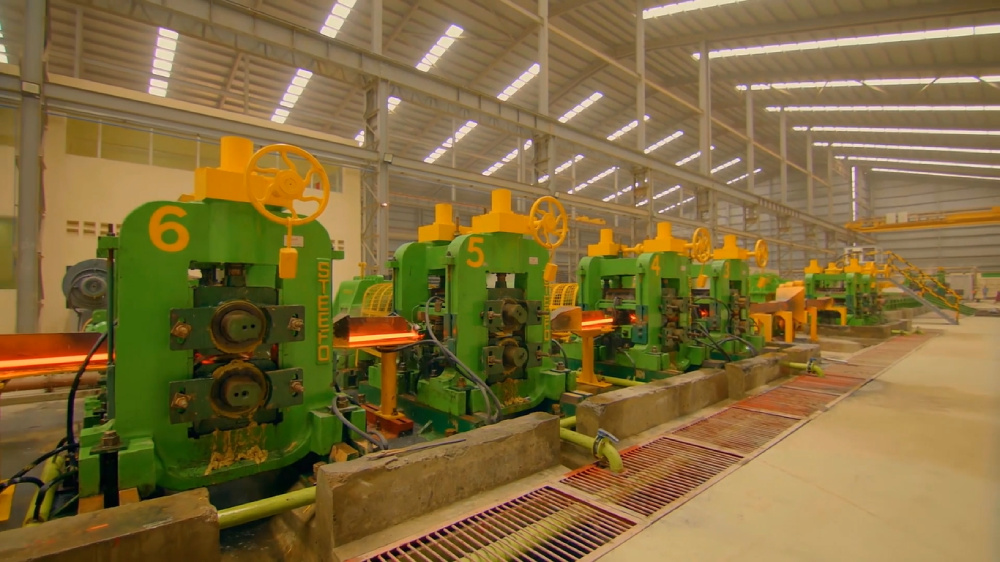
Steel producers are under pressure to deliver tighter tolerances, reliable mechanical properties, faster deliveries, and better traceability while still controlling energy use, yield losses, and downtime.
That is why automation has become a strategic layer in the modern TMT bar rolling mill. Production is judged by how consistently the mill can heat, roll, quench, cool, cut, and handle material with minimum variation. Leading suppliers now describe long-product automation in terms of quality, efficiency, reliability, monitoring, and data-driven decision-making.
For plant owners and technical heads, the key question is: where automation creates the most value in a TMT bar rolling mill, which features matter most, and how to choose an approach that improves plant performance.
What Does Automation Mean in a Modern TMT Bar Rolling Mill?
A Simple Definition
In practical terms, automation in a TMT bar rolling mill means using PLCs, drives, sensors, HMIs, SCADA systems, alarms, and process logic to control production more accurately and with less manual intervention. Leading global rolling mill automation providers describe modern rolling automation as an integrated control environment designed to improve productivity, quality, availability, and operator decision-making.
Automation Is Not Just One Machine
A common mistake is to think automation is a single panel added near the stands. In reality, a modern TMT bar rolling mill uses automation as a connected system across the line. Reheating furnace control affects billet temperature. Stand speed synchronisation affects rolling stability. Quenching control affects thermal treatment. Cooling bed handling affects bar flow and finishing consistency. This connected, plant-wide approach is consistent with how major suppliers describe common automation platforms, Level 2 systems, and closed-loop steel production control.
Key Building Blocks of a Rolling Mill Automation System
Most advanced rolling mills rely on a combination of:
- PLCs and control logic for repeatable process execution
- Drives and speed synchronisation for stable rolling conditions
- Sensors and temperature monitoring for real-time feedback
- HMI and SCADA dashboards for operator visibility
- Alarms, interlocks, and safety systems for quicker response
- Production data capture for KPI tracking and improvement
This structure aligns with how major long-product technology providers describe modern automation architectures for bar and rebar production.
Why Automation Has Become Essential in Modern TMT Bar Rolling Mill Setups
Demand for Higher Output Without Losing Quality
The market expects more throughput from every TMT bar rolling mill, but higher speed is useful only when product quality holds. Suppliers repeatedly position automation as the layer that helps mills raise productivity while maintaining quality, tolerance, and reliability. In TMT production, higher output means little if rolling instability, temperature variation, or inconsistent quenching creates off-spec bars.
Manual Dependency Creates Avoidable Variability
In a manual-heavy mill, good results often depend on a few experienced operators. Response time is slower, parameter changes may not be consistent from shift to shift, and troubleshooting becomes harder because process visibility is limited. Modern automation platforms are designed to improve visibility, stabilise control, and support faster operator response, which is exactly why manual dependency has become a competitive disadvantage in a high-speed TMT bar rolling mill.
Buyers Now Expect Process Reliability, Not Just Machine Supply
A TMT bar rolling mill is no longer evaluated only on installed equipment. It is evaluated on how reliably it can deliver repeatable output over time. That is why major suppliers now bundle electrics, automation, digital monitoring, and support with the rolling solution itself.
Where Automation Adds Value Across the TMT Bar Rolling Mill Line
1. Reheating Furnace Control
If billets enter the mill at inconsistent temperatures, the rest of the line must compensate. Automation improves furnace temperature regulation, heating consistency, and temperature homogeneity, which supports more stable downstream rolling and helps reduce losses tied to cold spots, overheating, and unstable rolling force.
2. Mill Stand Synchronisation and Rolling Control
This is one of the most important areas in any TMT bar rolling mill. Speed coordination between stands helps maintain stable bar movement and better tension control. Leading manufacturers emphasise precise process control, real-time monitoring, and performance optimisation in long-product mills because rolling stability directly affects productivity, dimensional consistency, and downtime.
3. Quenching System Control
In TMT production, quenching is central to final bar properties. Danieli’s rebar references describe the quenching system as installed after the fast-finishing block, where pressure water is used for in-line heat treatment to achieve the required material structure and mechanical properties. That is why automated control of water flow, pressure, timing, and bar movement matters inside a TMT bar rolling mill.
4. Cooling Bed and Material Handling Automation
After thermal treatment, controlled transfer and cooling are critical. Manufacturers show how modern bar lines integrate high-speed cooling bed entry and finishing-end systems to support productivity and stable bar handling. For mills upgrading finishing sections, automatic cooling beds help reduce handling errors, improve sequencing, and support smoother flow toward bundling and dispatch.
5. Shearing, Cutting, and Finishing Operations
Automated shearing and cut-length control improve repeatability and reduce the need for frequent manual correction. Accurate cut-length control also helps improve yield and overall production efficiency in bar mills. In a busy TMT bar rolling mill, this affects both productivity and commercial recovery.
6. Data Monitoring and Operator Dashboards
Real-time dashboards give operators and supervisors a live view of speed, temperatures, alarms, equipment status, and production trends. Advanced rolling mill analytics systems also support data acquisition, KPI monitoring, fault analysis, and visualisation, helping teams make faster decisions and maintain better process control.
The Biggest Benefits of Automation in the TMT Bar Rolling Mill Performance
1. More Consistent TMT Bar Quality
When a TMT bar rolling mill controls temperature, speed, quenching conditions, and cut lengths more precisely, the plant is better positioned to maintain dimensional accuracy and repeatable bar properties across batches. That consistency matters to both projects and TMT bar suppliers who depend on a reliable market reputation.
2. Higher Production Efficiency
Automation reduces delays between process steps, improves coordination across equipment, and supports faster correction when operating conditions change. That is why leading suppliers consistently connect long-product automation with higher productivity and operating efficiency.
3. Lower Unplanned Downtime
Monitoring, alarms, analytics, and better visibility help teams identify abnormalities earlier. Digital monitoring systems are closely associated with better predictability, continuous support, and stronger fault prevention in modern rolling operations. An automated TMT bar rolling mill gives teams more time to act before a small issue becomes a stoppage.
4. Better Yield and Less Process Loss
Yield losses often hide in unstable rolling, inaccurate cutting, cobbles, overprocessing, or off-spec output. Automation reduces many of these avoidable losses by improving control and repeatability. Digital rolling solutions are also closely associated with better quality, improved yield, and higher throughput in modern mill operations.
5. Improved Energy Efficiency
Energy waste increases when process conditions fluctuate, reheating is inconsistent, or rework rises. Better coordinated control helps the mill use equipment more effectively and avoid unnecessary instability. Digital optimisation in metals manufacturing is also widely associated with improved resource efficiency and lower process waste.
6. Safer Plant Operations
A modern TMT bar rolling mill still needs skilled people, but it should not depend on excessive manual intervention in hot, fast, or hazardous zones. Automation improves safety through interlocks, alarms, visibility, and controlled responses. Advanced sensing and monitoring systems are also increasingly linked to safer long-rolling operations.
Manual vs Automated TMT Bar Rolling Mill Operations: What Really Changes?
The real difference is how decisions are made, how fast the process responds, and how visible plant performance becomes.
| Area | Manual-heavy mill |
Automated mill |
| Process control | More reactive | More stable and programmed |
| Quality consistency | More shift-to-shift variation | Better repeatability |
| Downtime response | Slower diagnosis | Faster alarms and visibility |
| Data visibility | Limited or delayed | Real-time dashboards and KPI tracking |
| Operator workload | Higher manual dependency | More supervisory control |
| Scalability | Harder to expand smoothly | Better suited to higher output and future upgrades |
A simple example makes the economics clearer. If a 30-tonne-per-hour TMT bar rolling mill loses just 15 minutes of productive time per 8-hour shift because of avoidable adjustments or delayed troubleshooting, that is roughly 7.5 tonnes of missed hourly-equivalent output per shift. Over a month, the commercial impact can become much larger than the visible automation cost.
Which Automation Features Matter Most for TMT Bar Rolling Mill Manufacturers?
1. Real-Time Monitoring
Operators should be able to see line speed, furnace conditions, alarms, quenching parameters, and equipment status in one place. Visibility is the foundation of faster response.
2. Speed and Tension Control
This is essential for stable rolling and reduced process disturbance. Leading suppliers specifically highlight impact control, speed recovery behaviour, and mill process expertise because front-end disturbances and rolling instability can cascade quickly through the line.
3. Quenching and Cooling Control
For a TMT bar rolling mill, this is mission-critical. Controlled water flow, thermal treatment repeatability, and reliable transfer to automatic cooling beds directly affect finished bar performance and finishing stability.
4. Production Analytics and KPI Tracking
KPI tracking helps teams identify bottlenecks, recurring alarms, unstable sizes, or underperforming shifts. That is why Level 2 and data-oriented systems are becoming more common in advanced rolling mills.
5. Predictive Maintenance and Condition Monitoring
Predictive maintenance helps plants move from breakdown response toward earlier planning. It supports continuous monitoring, earlier issue detection, improved uptime, and stronger overall equipment performance.
Common Automation Challenges in Rolling Mills and How to Plan for Them
1. Integrating New Automation With Existing Machinery
Not every plant installs a completely new TMT bar rolling mill. Many modernisation projects happen in phases rather than all at once. Existing mills are often upgraded step by step by improving controls, drives, monitoring systems, or finishing sections based on current production needs and budget. That makes phased automation a practical and commercially sensible path for many manufacturers.
2. Training Operators and Maintenance Teams
Even the best system underperforms if teams do not trust it or use only a fraction of its capability. Commissioning, operator training, maintenance familiarisation, and after-sales support are therefore part of the automation decision.
3. Managing Data Without Creating Complexity
More data is not automatically better. The right TMT bar rolling mill automation setup should show operators what they need to act on, not flood them with unread information.
4. Cost Concerns and ROI Expectations
Upfront cost matters, but serious buyers should evaluate automation against output stability, yield recovery, lower stoppages, energy performance, labour effectiveness, and future scalability.
How to Choose the Right Automation Approach for a TMT Bar Rolling Mill
Start With Your Production Goals
Define what you want the mill to achieve: higher throughput, tighter consistency, more size flexibility, better traceability, lower energy intensity, or expansion readiness.
Evaluate Your Current Bottlenecks
Look closely at where losses occur:
- Frequent minor stoppages
- Inconsistent bar quality
- Manual dependency at critical points
- Poor visibility during running conditions
- Energy inefficiency
- Finishing or cooling delays
Think Beyond Equipment Supply
A strong TMT bar rolling mill partner should support commissioning, process tuning, training, service, troubleshooting, and future upgrades.
Choose a Partner That Understands Complete Rolling Mill Operations
A modern TMT bar rolling mill does not perform well when automation is treated as a separate layer from the rest of the plant. Control logic must work in step with mill mechanics, process metallurgy, thermal treatment, material flow, and finishing requirements. If these areas are not aligned, even advanced automation can struggle to deliver stable results.
That is why it is important to choose a partner that understands the full production chain, not just drives, panels, or software. In a TMT bar rolling mill, furnace temperature affects rolling behaviour, rolling stability affects quenching performance, and quenching consistency influences final bar properties. Cooling, shearing, and handling must also stay synchronised to avoid downstream disruption.
A supplier with complete rolling mill expertise can design automation around actual plant conditions, production goals, and product requirements. This leads to a more practical system with better coordination across the line, easier operator use, smoother commissioning, and stronger long-term performance.
Key Takeaway
Automation is no longer a premium add-on in the modern TMT bar rolling mill. It is a practical operating advantage that helps mills produce more consistent bars, improve yield, respond faster, reduce avoidable downtime, and make better decisions with real process visibility.
Real value lies in combining rolling mill know-how with the control, coordination, and long-term support that modern steel production now demands. If your team is evaluating a new TMT bar rolling mill or planning an automation upgrade, start with plant goals and process bottlenecks, not just equipment price.
Frequently Asked Questions
1. What is automation in a TMT bar rolling mill?
It is the use of control systems, sensors, drives, PLCs, HMIs, SCADA, and process logic to run the mill more accurately, consistently, and safely with less manual dependency.
2. Why is automation important in modern TMT bar production?
Because modern bar production demands consistency, speed, lower losses, better traceability, and faster decision-making. Automation helps the mill deliver all of these more reliably.
3. Which parts of a TMT bar rolling mill can be automated?
Key areas include reheating furnace control, stand synchronisation, quenching, automatic cooling beds, shearing, cut-length control, material handling, alarms, and production analytics.
4. Does automation improve TMT bar quality?
Yes. Better control over temperature, speed, timing, and thermal treatment improves process repeatability, which supports more consistent bar quality.
5. Can existing rolling mills be upgraded with automation?
Yes. Many plants modernise in stages by upgrading controls, drives, monitoring, or finishing sections instead of replacing the full line at once.
6. How does automation help reduce rolling mill downtime?
It improves visibility through alarms, condition monitoring, data analysis, and faster troubleshooting so teams can detect and address issues earlier.
Build a Smarter TMT Bar Rolling Mill with The Steefo Group
Automation delivers the greatest value when it is backed by deep rolling mill expertise. At The Steefo Group, we understand that a high-performing TMT bar rolling mill depends on more than individual machines or isolated control systems. It requires the right balance of process design, mill stability, thermal treatment, material handling, and dependable automation across the full production line.
Our team works closely with steel manufacturers to deliver practical, performance-focused solutions that improve consistency, reduce operating losses, support higher productivity, and prepare plants for long-term growth. Whether you are planning a new mill, modernising an existing setup, or evaluating automation upgrades, we help you take a complete and technically sound approach.
If your goal is to build a more reliable, efficient, and future-ready TMT bar rolling mill, connect with The Steefo Group to explore the right solution for your plant.
14 replies on “The Importance of Automation in Modern TMT Bar Rolling Mill Operations”
Finally found a platform that actually pays out on time. I had a great run last night and the support team was very helpful. Check out vn888new3
I’ve been trying a few different sites lately and this one really stands out. The interface is smooth and the payouts are surprisingly fast. Definitely worth a look for anyone who likes a reliable platform. Check out vn12nk88
Feels just like a real casino experience from the comfort of my home. The payouts are decent and the site is secure. Try vegas969login.
Finally found a working link for the APK. Installation was a breeze and the app runs perfectly on my Android phone. Great job on the optimization! jjwingamedownloadapk
Betting used to be such a hassle with outdated sites, but this platform changes the game completely. I love how quick the deposits are and the live dealer tables feel just like a real casino floor. Give it a try when you get a free moment. jojobetguncelgiris
Super impressed with the mobile optimization. I can play on the go without any lag at all. Great job on ph75jili!
Finally found a place that doesn’t lag during the big wins. The login process is quick and the support team is actually helpful. Give jb777login a try
The game selection is massive and the community vibes are great. I’ve met some cool people while playing here. Check out rs789game for some action.
[9177]cv9991 লগইন এবং অ্যাপ ডাউনলোড | বিকাশ ক্যাসিনো স্লট গেম,cv9991 login করুন এবং cv9991 app download করে সেরা স্লট গেম উপভোগ করুন। বিকাশ দিয়ে অনলাইন ক্যাসিনো ডিপোজিট করে আজই খেলা শুরু করুন। visit: cv9991
Finally found a place where the bonuses actually make sense. Had a great run last night and the interface is very user-friendly. Check out g7777casino if you want some real action.
I’m really impressed with the bonuses they offer to new players. It gives you a great head start and the customer support is very helpful. Keep it up. phpanalo888
Just hit a decent win here! The interface is very user friendly and the variety of slots is impressive. Cheers to 55jilicasino for the great experience.
Quick login and no annoying bugs. I really appreciate how stable the connection is even on mobile data. Loving the service at jili44login.
Super easy registration process and the graphics are top notch. It feels very professional and secure. I am loving my time at phj8ph9.