
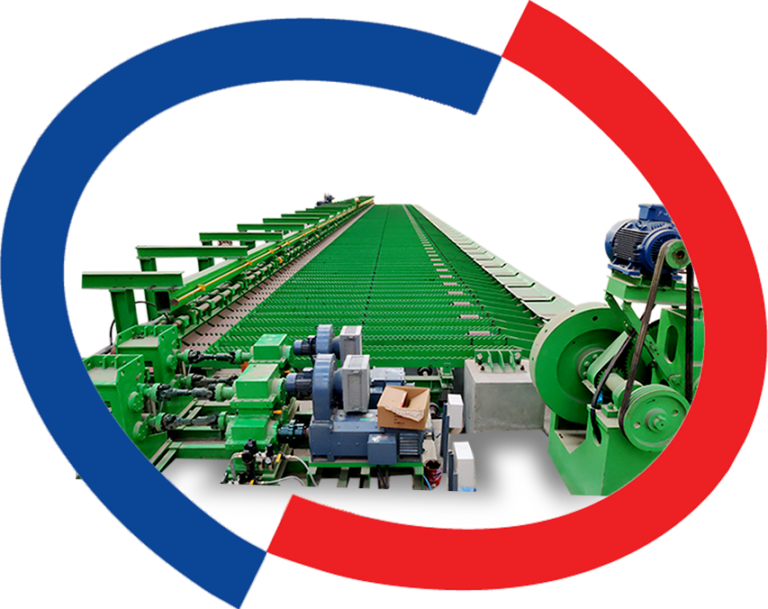
A cooling bed that’s undersized for a mill’s actual output doesn’t fail dramatically — it just quietly becomes the ceiling on everything upstream. The rolling stands can be perfectly capable of higher throughput, but if the bed can’t clear bars fast enough, the whole line runs at the bed’s pace, not the mill’s. This is one of the more common sizing mistakes plants run into when expanding output or adding a new product range, and it’s rarely obvious until the mill is already running below its real capacity.
Cooling bed sizing refers to determining the correct length and width of a rolling mill’s cooling bed based on the maximum run-out bar length, saleable product lengths, mill productivity in tons per hour, and the cooling time required for the bar sections being produced.
Get this calculation right at the specification stage, and the cooling bed matches the mill’s output for its full operating life. Get it wrong, and a plant either overspends on an oversized bed it will never fully use, or installs a bed that caps throughput the moment the mill is pushed toward its rated capacity. This guide walks through what actually determines cooling bed length and width, and how to avoid the sizing mistakes that show up most often during mill upgrades and retrofits.
This matters more now than it did a decade ago, because mills are increasingly specified with future output growth in mind rather than a single fixed production target. A cooling bed is one of the more capital-intensive and space-consuming pieces of equipment on the discharge end of a mill, which makes it one of the most expensive components to get wrong — and one of the most disruptive to retrofit once civil foundations and downstream handling equipment are already built around it.
Why Undersized Cooling Beds Become a Production Bottleneck
A cooling bed sits downstream of the last finishing stand, and everything the mill produces has to pass through it before it can be bundled and dispatched. If the bed’s length or rake capacity can’t keep pace with the bar coming off the mill, bars start backing up at the infeed — which forces the mill to either slow its rolling speed or stop intermittently to let the bed clear, regardless of what the stands themselves are capable of.
There’s a second, less visible risk: a bed sized too tight for the bar length being produced can force cross-transfer before the bar has cooled evenly along its full length. Since the goal of a cooling bed is to bring the entire bar length down to a uniform temperature at the same time, premature transfer can develop internal stress unevenly across the bar — a quality issue that often isn’t caught until later inspection, by which point a batch may already be compromised.
The cost of either failure mode compounds over the equipment’s operating life. A bottleneck caused by an undersized bed isn’t a one-time inconvenience — it caps the plant’s effective output on every single shift for as long as the bed remains in service, which for a piece of equipment expected to run for fifteen to twenty years represents a substantial, ongoing opportunity cost that rarely shows up as a single line item anyone budgets against.
What Determines Cooling Bed Length
Cooling bed length is governed primarily by two factors working together, not by a single fixed number.
Maximum Run-Out Bar Length
The bed has to be long enough to accommodate the longest bar length coming off the finishing stand at full mill speed. This is the starting constraint — a bed shorter than the maximum run-out length simply can’t receive the bar in one piece, forcing an intermediate cut before the bed that most mills would rather avoid.
Saleable Length Optimization
Beyond the minimum length needed to receive the bar, length is optimized against the plant’s saleable bar lengths to minimize crop losses — the scrap generated at the head and tail ends of each bar during final cutting. A bed length that divides cleanly into standard saleable lengths (commonly in the 8 to 24 meter range for commercial bar products) reduces the proportion of each run that ends up as crop scrap rather than sellable product. In practice, most structural and TMT bar mills run cooling beds somewhere between 40 and 100 meters, depending on mill size, output target, and product mix — a mid-sized TMT rolling line, for example, commonly runs a bed in the 60-70 meter range paired with a matching run-out roller table of similar length.
The economics here are worth spelling out, because the length-to-saleable-length relationship isn’t intuitive at first glance. If a bed is sized to a length that divides awkwardly into a plant’s most common saleable lengths, every single cooling cycle generates a slightly larger crop loss than necessary — and because that loss repeats on every bar, every shift, for the life of the equipment, even a small inefficiency in this calculation compounds into a meaningful yield loss over a year of production. Plants that review their actual saleable length mix before finalizing bed length, rather than defaulting to a round number, typically see a measurable improvement in yield versus a bed sized without that step.
What Determines Cooling Bed Width
Where length is mostly a function of bar length and crop optimization, width is driven by a different set of variables entirely.
Mill Productivity (Tons/Hour)
A higher-output mill produces more bars per minute, which means more bars need to sit across the bed’s width simultaneously while they cool. Width has to scale with throughput — a bed sized for a 30-ton-per-hour mill will bottleneck immediately if the same mill is later upgraded to run at 50 tons per hour, even if length was specified generously.
Required Cooling Time for Your Bar Sizes
Larger bar sections hold heat longer and take correspondingly more time to cool to a safe handling and bundling temperature. Since every bar needs to spend that full cooling time on the bed before being cross-transferred off, a mill running larger sections — or a wider product mix spanning small and large diameters — generally needs more width to keep bars moving through without rushing the slowest-cooling sections.
Natural Air Cooling vs. Forced Blower Cooling
Natural air cooling is the standard approach on most beds and is sufficient for the great majority of bar sections and production rates. Where a mill is running larger sections, higher tonnage, or simply needs a shorter cycle time to free up bed width faster, blowers can be added to accelerate the cooling rate. This is a meaningful design choice at the sizing stage: a plant that expects to need faster cycle times down the line can specify blower-ready infrastructure upfront, which is considerably cheaper than retrofitting forced-air cooling onto a bed that was never designed for it.
A Simple Framework to Estimate Cooling Bed Capacity
Before finalizing a spec with a manufacturer, run through these four questions — they map directly to the length and width variables above and surface most sizing mistakes before they’re built into steel.
| Question | What It Determines | Typical Range (Structural/TMT Bar Mills) |
|---|---|---|
| What’s the longest bar length exiting the finishing stand at full speed? | Minimum bed length | Varies by mill design |
| What saleable lengths do we sell most of? | Optimized bed length to minimize crop loss | 8–24 m saleable lengths; 40–100 m bed length |
| What’s our target output in tons/hour, including planned future upgrades? | Bed width | 8–12 m width for standard bar mills |
| What’s our largest bar section, and how long does it take to cool safely? | Width and cooling method (natural air vs. forced blower cooling) | Depends on section size and mix |
The practical takeaway: size the bed to your output target, not just your current output. A bed specified tightly to today’s tonnage is the single most common reason plants find themselves bottlenecked within a few years of installation.
Common Sizing Mistakes When Upgrading or Expanding a Mill
The sizing mistakes that show up most often aren’t calculation errors — they’re planning horizon errors. A plant specifies a cooling bed correctly for its current output and product mix, then finds the bed undersized within a few years once output ramps up or a larger bar section is added to the range. Because a cooling bed retrofit means more than just adding rake length — it often requires reworking the roller table feeding it and the downstream handling equipment as well — sizing for a growth target from the outset is almost always cheaper than retrofitting later.
A second common mistake is sizing the bed around average output rather than peak output. Mills rarely run at a perfectly flat tonnage rate — output varies by shift, by product being rolled, and by campaign length. A bed sized to average throughput will bottleneck during every peak-output run, which for many plants is exactly when cooling bed capacity matters most.
A third mistake worth flagging specifically: treating the cooling bed as an isolated piece of equipment rather than part of a connected handling sequence. A bed that’s correctly sized on its own can still create a bottleneck if the roller table feeding it, or the bundling line receiving bars from it, wasn’t sized to the same output target. Capacity planning that looks at the cooling bed in isolation, without checking it against the equipment immediately upstream and downstream, is one of the more common reasons plants discover a bottleneck in a place they weren’t expecting.
How Steefo Sizes Cooling Beds for New & Retrofit Projects
The Steefo Group designs and manufactures automatic cooling beds matched to a plant’s actual product range and output targets — not a generic standard size adjusted after the fact. For new installations, this means working from your mill’s finishing stand speed, saleable length mix, and output target to size both length and width before the bed is ever fabricated. For retrofit projects on an existing line, our engineering team evaluates what can be extended or reworked within your current floor space and downstream bundling setup, so an upgrade to bed capacity doesn’t require rebuilding the entire discharge end of the mill.
Getting cooling bed capacity right comes down to treating it as an output-matching exercise, not a one-time fixed specification. Length has to accommodate your longest run-out bar while staying optimized against your saleable lengths to minimize crop loss, and width has to scale with both your current tonnage and where that tonnage is headed. Plants that size for growth from the outset avoid the far more disruptive retrofit of discovering, mid-expansion, that the cooling bed — not the mill stands — is what’s actually capping output.
Frequently Asked Questions
What determines cooling bed length in a rolling mill?
Cooling bed length is determined by the maximum run-out bar length coming off the finishing stand, optimized against your saleable bar lengths to minimize crop losses. Most structural and TMT bar mills use cooling beds between 40 and 100 meters long, depending on mill size and product range.
How is cooling bed width calculated?
Cooling bed width is calculated from mill productivity in tons per hour and the cooling time required for your largest bar section. Higher throughput or slower-cooling sections require more parallel bar positions across the bed, which increases width — typically in the 8 to 12 meter range for standard bar mills.
What happens if a cooling bed is undersized for mill output?
An undersized cooling bed becomes the production bottleneck: bars back up at the bed infeed, forcing the mill to slow down or stop regardless of how fast the stands can roll. It can also mean bars are cross-transferred before fully cooling, risking uneven internal stress and dimensional defects.
Can an existing cooling bed be resized or extended?
In many cases, yes — extending bed length or adding rake capacity is a common retrofit when a mill upgrades output or adds a larger bar section. Whether it’s feasible depends on available floor space and whether the existing drive and rake mechanism can handle the added load.
Does Steefo size cooling beds for specific mill output requirements?
Yes. Steefo designs and manufactures automatic cooling beds matched to a plant’s specific product range, output targets, and layout — for both new installations and retrofit projects. Contact our engineering team with your mill’s output and product specifications for a sizing recommendation.
Get in Touch
To get help sizing a cooling bed for your mill’s output target, see our full range on the automatic cooling beds product page, read more on how automatic cooling beds work, or reach out to our engineering team directly. Call us at +91 98240 76873 or write to marketing@thesteefogroup.com.