
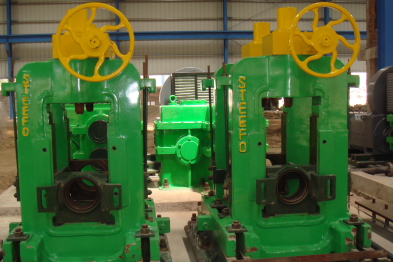
Two rolling mills can roll the same bar and still be built on opposite ideas. In a continuous mill, the bar runs through stands set in one straight line. In a looping mill, the stands sit side by side, and the hot bar swings through a loop on its way to the next stand. This guide on looping mill vs continuous mill explains how each layout works, where each one fits, and what to ask before you commit to either.
The choice matters because layout sets output, tension control, floor space and how easily a plant can change products. It is also one of the hardest decisions to reverse once the foundations are poured.
A looping mill is a rolling mill for bar stock and wire with successive stands side by side, so the metal forms a loop in passing from stand to stand. A continuous mill places its stands in tandem, so the bar travels through them without stopping and sits in several stands at once. The rest of this guide builds on those two definitions.
Quick answer: A continuous mill places its stands in one straight line, so a bar sits in several stands at once and every stand must run at a matched speed to keep tension low. A looping mill places its stands side by side and lets the hot bar form a loop between stands, which absorbs small speed differences. Published sources describe continuous layouts as the high-output, high-automation option and looping layouts as easier to change over but lower in speed and output. Cross-country and semi-continuous mills are related variants of the same ideas. The right layout depends on your target capacity, product mix, billet size and available floor space, not on one design being better in every case. Check four things before you decide: your output target, the bar sizes you roll, your billet size and the plot length you can spare. The sections below compare both layouts with sources.
What Is a Continuous Rolling Mill?
A continuous mill is a rolling mill whose stands are arranged one after another in tandem. Hani Tech’s rolling mill guide describes the billet moving through the stands without stopping, with its cross-section reduced at each stage. Bar mills for rebar, wire rod mills and section mills are all built this way.
The idea is old. An older mechanics text by G. W. Danforth defines the continuous mill as a succession of small two-roll mills placed near together in line, and it explains why. Small bars lose heat quickly, so they must be rolled fast. In that design, a bar can be in as many as ten pairs of rolls at once.
That simultaneous contact creates the central engineering problem. When a bar sits in two stands at once, those stands must agree on speed. Ispatguru notes that in a continuous mill the stand speed must be controlled to ensure tension-free rolling, and that loopers are provided between stands wherever necessary. Modern lines add cascade speed control, which uses a reduction ratio (the R-factor) to set each stand’s speed reference from the one before it.
Output and Automation in Continuous Mills
Continuous layouts are the usual answer when volume matters. Ispatguru states that bar and light section mills are normally sized for a medium production range of up to 500,000 tonnes a year, and that higher capacity is handled by building a multi-strand mill. The same source says rebar mills can be designed for capacities of over 1 million tonnes.
SME Group adds that continuous lines raise automation levels and allow stepless speed regulation through DC motors or AC variable speed drives. It also describes no-twist rolling, where stands alternate between horizontal and vertical positions so the bar does not need twisting between passes. Our guide to choosing DC motors for hot rolling mill applications covers the drive side of this in more detail.
What Is a Looping Mill?
A looping mill is a rolling mill for bar stock, wire and similar products, with the stands side by side, so the metal forms a loop as it passes from one stand to the next. That is the dictionary definition (Dictionary.com, from the Random House Unabridged Dictionary), and it points at the one feature that separates this layout from the others: the loop.
Danforth describes the same arrangement from the shop floor. A red-hot rod, a hundred or more feet long, passes from the first mill in a U-shaped loop through the next. He notes that the material was used mostly for drawing into wire. That is a historical account, but the mechanical principle has not changed.
How the Loop Actually Works
The loop is a buffer. Ispatguru explains that a repeater receives the workpiece as it emerges from one stand and guides it into the next. The speeds are matched so that the following stand runs slightly slower than the balancing speed, which causes the loop to grow in size. When conditions push the loop too far, the repeating channels allow the stock to kick out onto a flat table.
Put simply, the stock does not have to be perfectly synchronised from stand to stand. The loop soaks up the difference. The cost is space for the loop, and an operating routine that keeps the loop within safe limits.
On product flexibility, Hani Tech’s overview of rolling processes says looper rolling is convenient for changing rolling products, but the rolling speed and output are low. It suits special sections and small batches. That trade-off sits at the centre of the layout decision.
How Does Each Layout Achieve Tension-Free Rolling Between Stands?
A continuous mill keeps tension low by matching stand speeds, often with loopers in the high-speed section. A looping mill lets the bar form a free loop between stands, so the loop absorbs speed differences instead of the bar stretching or buckling. Both layouts aim for tension-free rolling or a light, constant tension.
Tension matters because it shows up directly in the product. LMM Rolling Mill’s technical article on continuous bar and wire rolling states that the greater the tension, the greater the size difference between the head, middle and tail of a rolled piece. It describes the function of the looper as realising tension-free or slightly constant tension rolling between mills, and says looper control is used in the high-speed area to achieve it.
The same article lists some working targets. These come from one manufacturer’s guidance, so treat them as reference points rather than universal limits:
- The change in motor current when steel bites should stay within 8% of the mill’s total current, with 3–5% as the target.
- Cascade speed change on the first mill should ideally sit between 1% and 5%, with a maximum of 10%.
- Abnormal tension can move the cross-section by 5–15% when steel is stacking and by 3–8% when it is pulling.
Ispatguru makes the same point in plainer terms: tension and loop control between stands reduces the material stress along the mill and improves dimensional accuracy. Whichever layout you choose, the control system matters as much as the arrangement of stands. Our guide on loopers in steel rolling mills covers vertical and horizontal looper types and how to choose between them.
What Other Types of Rolling Mill Layouts Exist?
Two other types of rolling mill layouts come up often: the cross-country mill, with widely spaced parallel stands, and the semi-continuous mill, which combines a reversing or looping roughing section with continuous finishing. Both are variants of the two designs above, so they matter whenever you compare layout options for a new plant.
Cross-Country Mills
Ispatguru explains that a cross-country mill takes its name from the arrangement of its stands: the centre lines of the roll stands are parallel to each other. The stands sit so far apart that the piece must leave one set of rolls before entering the next. The source says the layout is used for mills with low capacities, and is often adopted because the space available is limited.
It is not the same as a looping mill. Ispatguru notes that cross-country mills suit sections which, because of their size or shape, are not adaptable to loop rolling. They can roll rounds, reinforcement bars, squares, flats and sections.
The same source lists the trade-offs. The layout limits the maximum length of the steel product that can be rolled, and it limits the maximum reduction that can be achieved. On the positive side, changing the rolling direction after each pass has a good effect on product quality and leaves very little directionality in the mechanical properties.
Semi-Continuous Mills
Britannica defines a semicontinuous mill as one in which the workpiece is passed back and forth through a reversing mill before being sent through the rest of the line. Hani Tech describes one common form as shuttle or looper rolling for the roughing section and continuous rolling for finishing. SME Group says the semi-continuous mill replaces the older open-train mill, and claims a continuous line can save up to 30% more energy than the semi-continuous process, helped by hot delivery and hot charging of billets. That is a vendor claim, and the saving depends on the plant’s billet supply.
Continuous Mill vs Looping Mill: Side-by-Side Comparison
The table below puts the two layouts next to each other, using only what published sources state. Where a source does not give a figure, the table says so rather than guessing.
| Factor | Continuous mill | Looping mill | Source |
|---|---|---|---|
| Stand arrangement | Stands in tandem, in one line | Stands side by side | Hani Tech; Dictionary.com |
| How the bar moves | Sits in several stands at once | Passes from stand to stand through a loop | Danforth; Dictionary.com |
| Tension handling | Matched stand speeds, cascade control, loopers where needed | The loop absorbs speed differences between stands | Ispatguru |
| Output | Highest production efficiency; modern lines run from 500,000 to over 1 million tonnes a year | Lower rolling speed and lower output | Hani Tech |
| Changing products | Difficult to change product variety | Convenient to change products | Hani Tech |
| Automation | High; stepless drives and no-twist rolling | Not specified in the sources reviewed | SME Group |
| Typical products | Rebar, wire rod and sections | Small bar and wire (historical source) | Hani Tech; Danforth |
Two cautions apply. First, the sources describe the layouts in general terms, and real plants mix features, such as loopers inside a continuous line. Hani Tech uses the term “looper rolling” for the loop-based practice described in the looping column. Second, none of the sources we reviewed gives a single capacity cut-off between the two layouts. Hani Tech’s guide suggests a semi-continuous or cross-country arrangement for plants in the 50,000 to 150,000 tonne a year range, but that is a guide, not a rule.
Which Layout Suits Which Plant?
There is no universal winner. The layout that works for a 50,000 tonne plant with several product sizes is rarely the one that works for a high-volume rebar line. These are the questions that separate the options in practice:
- Target capacity. Continuous lines are built for volume. Cross-country and looping layouts are described in the sources as lower-capacity options.
- Product mix. A plant that changes sizes often values easy changeover. A plant that runs a narrow range all year values speed.
- Billet size and furnace. The size of the incoming billet affects the number of stands and the furnace you need. Our basics of reheating furnaces guide covers the furnace side.
- Floor space. Ispatguru links cross-country layouts to limited space. A continuous line needs enough straight length for every stand, and a looping mill needs room for the loops.
- Automation and manpower. Continuous lines depend on drive and tension control. Looping layouts need the loop kept within its limits, which is why repeater channels exist for the case where it grows too large.
- Budget and growth plans. A layout that suits today’s capacity may limit tomorrow’s. The rolling mill layout design guide explains how layout choices carry into maintenance access and expansion.
Where The Steefo Group Fits
The Steefo Group has built rolling mill equipment since 1976, and its TMT bar rolling mill solutions cover capacities from 8 TPH to 100 TPH, delivered from concept to commissioning. Its range includes mill stands, loopers and reheating furnaces. For a full plant, the turnkey solutions page explains how layout, equipment and commissioning come together under one contract.
If you are still working out the line-up of stands, the guide to roughing, intermediate and finishing mill stands shows how each group contributes to the reduction. And if you want the broader picture first, start with what a rolling mill is.
What Mistakes Should You Avoid When Choosing a Layout?
Four mistakes are worth avoiding in project planning. Each one comes from deciding on one factor and ignoring the rest.
- Buying for peak output only. A continuous line sized for high volume sits idle if billet supply or market demand cannot feed it. Check demand before you size the line.
- Underestimating tension control. The LMM figures above show how quickly tension turns into size variation. Budget for drives and looper control from the start, not as an add-on.
- Ignoring changeover frequency. If you roll many sizes, a layout that is slow to change products will cost you in lost hours. Hani Tech’s point about product flexibility applies directly here.
- Leaving no space for loops and maintenance. Whatever the layout, loopers, repeaters and guides need clear access. A plan that fits the equipment on paper but blocks maintenance routes creates problems later.
Cost belongs in the same conversation. Layout, automation and furnace choices all move the total investment, which our TMT rolling mill plant cost guide breaks down by component.
Frequently Asked Questions
What is the main difference between a looping mill and a continuous mill?
The main difference is how the bar travels between stands. In a continuous mill the stands sit in tandem, and the bar occupies several stands at once, so stand speeds must match. In a looping mill the stands sit side by side, and the bar forms a loop between stands that absorbs speed differences.
Is a looping mill the same as a cross-country mill?
No. A cross-country mill has parallel stand centre lines and stands set so far apart that the piece leaves one stand before entering the next. Ispatguru notes that cross-country mills suit sections that are not adaptable to loop rolling, so the two layouts are distinct.
Do continuous mills use loopers?
Yes. Ispatguru states that loopers are provided between stands wherever necessary for tension-free rolling, and LMM Rolling Mill notes looper control is used in the high-speed area. A continuous mill therefore uses stand speed control and loopers together.
Looping mill vs continuous mill: which gives higher output?
Continuous layouts. Hani Tech says the continuous design offers the highest production efficiency, and describes looper rolling as lower in speed and output. Ispatguru adds that bar mills are normally sized up to 500,000 tonnes a year, with multi-strand designs for more.
Which layout is better for a small plant with limited space?
No single layout wins. Ispatguru links cross-country layouts to low capacity and limited space, and Hani Tech suggests semi-continuous or cross-country arrangements for roughly 50,000 to 150,000 tonnes a year. Your product mix, billet size and growth plans should decide the final choice.
What capacity do The Steefo Group’s TMT bar rolling mills cover?
The Steefo Group’s TMT bar rolling mill solutions cover capacities from 8 TPH to 100 TPH. The right layout and equipment within that range depend on your product sizes, billet specification and site, so the engineering team scopes each project individually.
Choosing Your Layout With Confidence
The looping mill vs continuous mill decision, like most rolling mill layout choices, comes down to one trade-off: speed and automation against flexibility and simplicity. Continuous mills deliver volume and control, but they demand matched speeds, strong drives and a long straight footprint. Looping mills handle speed differences through the loop and change products easily, but published sources place them lower on speed and output.
Many plants end up with a mix of features, and cross-country and semi-continuous layouts give buyers a way to balance capacity, space, product range and budget. Work through the six questions above, check each answer against your site, and the layout usually becomes clear.
Planning a new TMT bar line and unsure whether the layout should be continuous, semi-continuous or looping? Share your target capacity, product range and plot size with The Steefo Group’s engineering team, and we will map the options against your project. Contact Us to start the conversation.
Sources
- Ispatguru: Rolling Mill and its Technological Equipments
- Ispatguru: Rolling of Steel in a Modern Long Product Rolling Mill
- Ispatguru: Main Features of a Modern Bar and Light Section Mill
- Ispatguru: Rolling of Steel and Major Equipment in a Cross-country Rolling Mill
- Dictionary.com: Looping Mill
- G. W. Danforth, An Elementary Outline of Mechanical Processes: Types of Rolling Mills
- Hani Tech: Rolling mill guide (continuous rolling mills)
- Hani Tech: Continuous Rolling, Semi-continuous and Slit Rolling
- LMM Rolling Mill: Tension Control in Continuous Bar and Wire Rolling
- SME Group: Continuous Rolling Mill Technology
- Britannica: Semicontinuous Mill
Last updated: November 2026.