
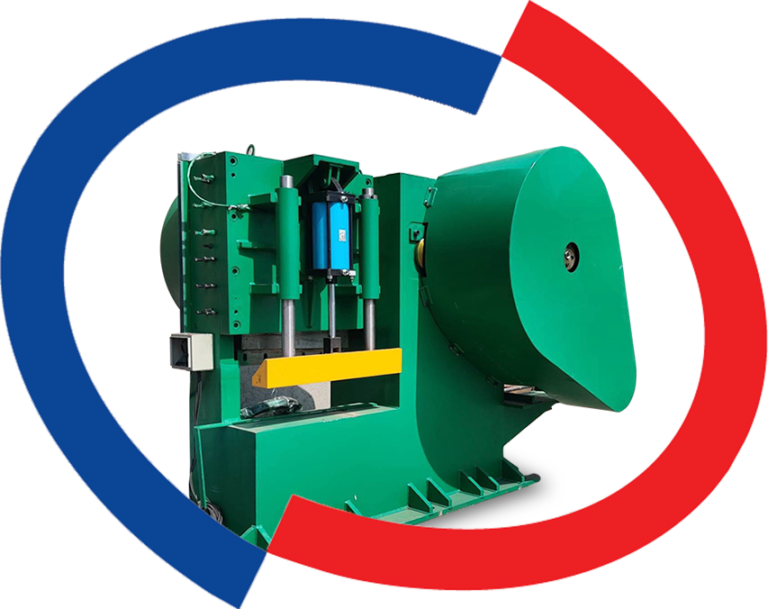
Every rolling mill line ends up needing more than one type of shear, and picking the wrong one for a given job shows up as either a speed bottleneck or a tolerance problem – not as an obvious equipment failure. Flying shears, continuous shears, crop and cobble shears, and their sub-types (rotary, pendulum) each get built for a specific point in the line and a specific job. This guide compares them side by side, so a plant team or buyer can quickly match the shear type to the application, rather than working through a full specification sheet for every option.
The confusion usually isn’t about whether a mill needs a shear – every line has at least one. It’s about which of five or six genuinely different configurations actually fits a given point in the process. Two shears that sound similar on a spec sheet can be built for completely different jobs.
A shearing machine cuts steel to length or trims its ends at defined points in a rolling mill line. The three core categories are the Flying Dividing Shear (cuts to length while material moves), the Continuous Shear (a higher-speed version of the same job), and the End Cutting Crop and Cobble Shear (trims front and tail ends and handles emergency cuts).
What Are the Main Types of Shearing Machines Used in Rolling Mills?
A hot rolling mill line typically uses shears at two distinct points: one type divides the finished product to commercial or cooling-bed length, and a different type trims the front and tail ends of material as it enters rolling. Steefo’s own equipment range covers three core types built around this split.
The Flying Dividing Shear cuts the rolled product to cooling bed length while the material keeps moving, without stopping the line. The Continuous Shear performs the same cooling-bed-length cutting job, built for higher finishing speeds than a standard flying shear can handle. The End Cutting Crop and Cobble Shear trims the front and tail ends of the material, and handles emergency segment cutting if something goes wrong mid-roll.
Beyond these three, the flying shear category itself splits further into sub-types – rotary and pendulum configurations – based on how the cutting motion actually happens. Those sub-types matter enough to cover on their own further down.
Flying Dividing Shear vs Continuous Shear: What’s the Difference?
Both shears do fundamentally the same job – cutting rolled product to cooling bed length without stopping the line – but they’re built for different speed ranges.
| Aspect | Flying Dividing Shear | Continuous Shear |
|---|---|---|
| Primary function | Cuts TMT bar and rolled product to cooling bed length | Same cooling-bed-length cutting role |
| Finishing speed | Up to 20 mps | Built for higher finishing speeds than a standard flying shear |
| Best fit | Standard-speed rolling lines | High-speed lines where a standard flying shear becomes the bottleneck |
| Line impact | Cuts without interrupting production | Cuts without interrupting production, at higher throughput |
The practical decision usually comes down to line speed. A rolling mill running near or below the Flying Dividing Shear’s 20 mps ceiling has no real reason to specify a Continuous Shear – it’s a higher-speed solution to a problem that doesn’t exist at that throughput. Once a line’s finishing speed pushes past what a standard flying shear can reliably handle, the Continuous Shear becomes the equipment that keeps cutting from turning into the limiting step in the line.
What Is an End Cutting Crop and Cobble Shear Used For?
Unlike the Flying Dividing Shear and Continuous Shear, which both cut finished product to length, the End Cutting Crop and Cobble Shear does a different job entirely: it trims the front and tail ends of material as it comes into the rolling process, and steps in for segment cutting if a cobble – a tangle or jam in the line – happens mid-roll.
This shear runs under PLC control specifically because cropped-length tolerance matters here in a way it doesn’t for a simple length cut. Front and tail ends carry more dimensional variation than the body of the bar, and cutting away too much wastes material, while cutting too little leaves out-of-spec material in the finished product. The PLC system holds tight tolerance on exactly how much gets trimmed, cut after cut, without relying on an operator judging it by eye each time.
Rotary vs Pendulum Shear: How Do These Flying Shear Sub-Types Differ?
Both rotary and pendulum shears fall under the flying shear category, but they reach the cut through genuinely different mechanisms. The motion is what separates them.
A rotary shear uses continuously rotating blades, synchronized to the material’s travel speed, to make the cut – a mechanically simpler, generally more cost-effective setup that suits standard crop and tail-end cutting well.
A pendulum shear suspends its cutting system in an oscillating, swinging configuration rather than continuous rotation. That oscillating motion lets a pendulum shear cut material whether it’s moving or stopped, which makes it a common choice specifically for cropping head or tail ends and for dividing hot input material as it’s fed into the rolling mill.
Neither sub-type replaces the other across the board – the choice depends on where in the line the cut happens and whether the shear needs to handle both moving and stationary material. For a deeper look at flying shear configurations generally, Steefo’s flying shearing machine guide covers the full range.
Mechanical vs Hydraulic Shear Drive: Does It Change Which Type You Need?
Drive mechanism is a separate decision layered on top of shear type, not a sixth category to choose between. It affects maintenance and flexibility more than which shear type fits the job in the first place.
Mechanical direct-drive shears run on a cam or crank mechanism tied directly to line speed. That direct mechanical link keeps the design relatively simple and generally easier to maintain, since there are fewer components translating motion into the cut – but it also means the cutting action stays tied to the mechanical linkage’s fixed relationship with line speed.
Hydraulic drive shears decouple the cutting action from a fixed mechanical ratio, giving more flexibility to adjust cutting force and timing independently of line speed. That flexibility matters most on lines where finishing speed varies across different products, since a hydraulic system can adapt cut timing without the mechanical constraints a cam-driven system carries.
Neither drive type is a universal upgrade over the other – a mechanically simpler direct-drive shear is often the right call on a line with consistent speed and product mix, while hydraulic drive earns its added complexity on lines that need that flexibility.
Quick Reference: Which Shearing Machine Type Fits Which Application?
| Application | Recommended Shear Type |
|---|---|
| Cutting rolled product to cooling bed length (standard speed) | Flying Dividing Shear |
| Cutting rolled product to cooling bed length (high speed) | Continuous Shear |
| Trimming front/tail ends, emergency segment cutting | End Cutting Crop and Cobble Shear |
| Cost-effective standard crop or tail-end cutting | Rotary Shear |
| Cropping or dividing material that may be moving or stopped | Pendulum Shear |
This table is a starting point, not a substitute for line-specific specification – actual bar size, finishing speed, and product mix all shift which shear makes sense for a given plant. For guidance on matching a shear to your specific line, Steefo’s shearing machine selection guide walks through the full criteria.
Conclusion
Shear selection comes down to two questions: what job is this shear actually doing – length cutting or end trimming – and what speed does the line need it to run at. Answer those and the choice narrows fast, usually from five shear types down to one. What takes longer is specifying the right capacity and tolerance for the specific line, not choosing between the categories themselves.
Steefo has manufactured shears for hot rolling mills for close to five decades. Flying Dividing Shears go up to 20 mps, Continuous Shears cover lines running past that ceiling, and PLC-controlled End Cutting Crop and Cobble Shears handle the tolerance-sensitive end trimming most spec sheets don’t fully explain. That range now runs in plants across India and export markets including Bangladesh, Kenya, and Saudi Arabia, on both mechanical and hydraulic drive configurations depending on the line.
Frequently Asked Questions
What is the difference between a flying shear and a continuous shear?
Both cut rolled product to cooling bed length without stopping the line, but a continuous shear is built for higher finishing speeds than a standard flying dividing shear can handle – up to 20 mps for the flying shear, higher for the continuous shear.
When is a crop and cobble shear used instead of a flying shear?
A crop and cobble shear trims the front and tail ends of material entering the rolling process and handles emergency segment cutting if a cobble occurs, while a flying shear cuts the finished product to length – they do different jobs at different points in the line, not competing options for the same cut.
What is the difference between a rotary shear and a pendulum shear?
A rotary shear uses continuously rotating blades synchronized to material speed, offering a simpler, more cost-effective setup for standard crop and tail-end cutting. A pendulum shear uses an oscillating cutting motion that can cut material whether it’s moving or stopped, making it suited to cropping and dividing hot input material.
Should I choose a mechanical or hydraulic drive for my shear?
Mechanical direct-drive shears suit lines with consistent speed and product mix, since the cam or crank mechanism is simpler and generally easier to maintain. Hydraulic drive suits lines where finishing speed varies across products, since it decouples cutting force and timing from a fixed mechanical ratio.
What cutting speed can a flying dividing shear handle?
Steefo’s Flying Dividing Shear is rated up to 20 mps finishing speed for cutting TMT bar and similar rolled product to cooling bed length.
How do I know which shearing machine type my rolling mill line needs?
Start with what job the shear needs to do – cutting finished product to length, or trimming ends as material enters rolling – then match capacity to your line’s finishing speed. A supplier familiar with your specific bar size and production mix can confirm the right configuration.
Looking to Upgrade or Select the Right Shearing Machine for Your Rolling Mill?
Flying shear, continuous shear, or crop and cobble – the right answer depends on where the cut happens in your line and how fast that line runs. Steefo’s engineering team has specified shears for rolling mills of every scale, from standard flying shears up to high-speed continuous configurations. Contact Us to talk through the right setup for your line.