
A single unplanned shutdown on a rolling mill can cost a plant lakhs of rupees in lost production for every hour the line stays down. Yet when a spare part needs replacing, many maintenance teams still default to whichever option is cheapest or fastest to source — without weighing what that choice actually risks. In 2026, with rolling mills running longer campaigns between planned shutdowns and lead times for critical components stretching to weeks, the OEM vs third-party spare parts decision has become a genuine cost-and-risk calculation, not a procurement afterthought.
OEM vs third-party spare parts refers to the choice between sourcing rolling mill components from the original equipment manufacturer — built to exact original specifications, tolerances, and materials — or from an independent supplier producing compatible or reverse-engineered alternatives, usually at a lower price.
The right choice isn’t universal: it depends on which part is failing, how critical it is to production, and how much downtime your plant can absorb while it’s replaced.
This guide breaks down when OEM spares are worth the premium, when a reputable third-party source makes sound engineering and commercial sense, and how to build a decision framework your plant can actually apply — part by part, not as a blanket policy.
Why This Decision Affects Uptime & Total Cost
Every spare parts decision in a rolling mill carries two costs: the price on the invoice, and the cost of being wrong. A gearbox pinion or mill stand bearing that fits slightly out of tolerance doesn’t just fail to perform — it can accelerate wear on the components around it, and in some cases cause secondary damage that turns a planned parts swap into an unplanned multi-day shutdown.
This is why experienced plant engineers evaluate spares on a criticality basis rather than a cost basis alone. A part that keeps the mill running when it fails unexpectedly — a drive-train gearbox, a mill stand roll assembly, a DC motor armature — sits in a different risk category than a bolt-on guide or a wear plate that can be swapped without stopping production. Third-party sourcing that works well for the second category can be genuinely costly for the first. It’s worth distinguishing this from routine steel plant consumables — items like refractories and casting materials that are replaced as a matter of course — since the sourcing risk profile for permanent spares is very different.
Industry MRO (Maintenance, Repair & Operations) planning frameworks used across the steel sector classify spares this way for exactly this reason: the storeroom isn’t just inventory, it’s insurance against the highest-cost failure scenarios a plant can face. A rolling mill running a 20-year-old gearbox, for instance, may find that the original manufacturer no longer stocks certain internals — which changes the sourcing question from “OEM or third-party” to “OEM-equivalent, reverse-engineered to original tolerances, or accept extended downtime risk.”
The Case for OEM Spares
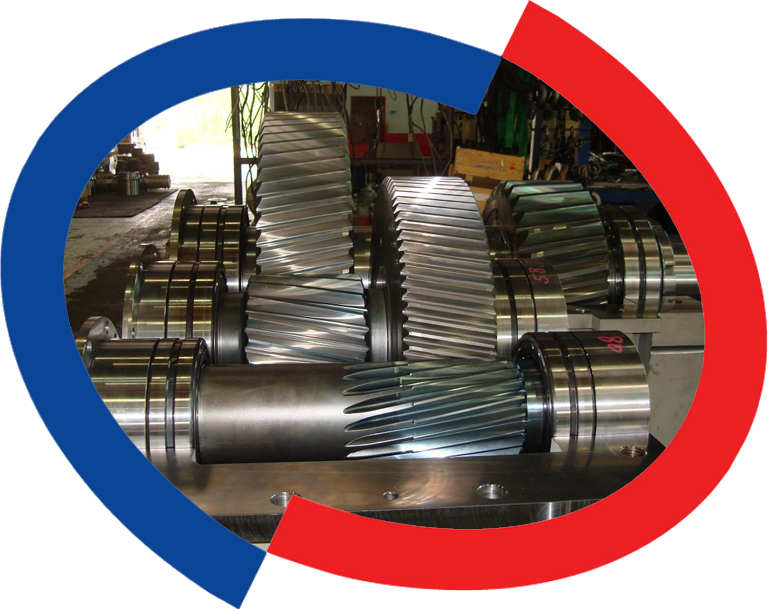
OEM spare parts are manufactured either by the original equipment maker or by a supplier working strictly to that manufacturer’s drawings, tolerances, and material specifications. For rolling mill equipment — gearboxes, mill stands, shears, cooling beds, and DC motors — this matters more than it does for less demanding machinery, because these components operate under sustained high load, heat, and vibration.
Quality & Fit Consistency
An OEM gearbox pinion or mill stand bushing is produced to the same dimensional tolerances as the part it replaces, which means installation doesn’t require on-site rework or adjustment. For high-load components like mill stand bearings or shear blades, even a small tolerance mismatch can shorten service life significantly.
Warranty & Accountability
OEM parts typically carry a manufacturer warranty, and — critically — installing them keeps the warranty on the surrounding equipment intact. If a mill stand or gearbox is still under its original equipment warranty, fitting a non-OEM part can void that coverage, shifting the entire risk of any subsequent failure onto the plant.
Predictable Lifecycle & Maintenance Planning
Because OEM parts are produced to a known material specification and heat-treatment process, their wear characteristics are predictable. This matters more than it sounds: a maintenance team that knows roughly how many operating hours a gearbox bearing or shear blade will deliver can schedule its replacement during a planned shutdown, rather than discovering the part has failed mid-campaign. Third-party parts sourced without verified material data make this planning far less reliable, since two batches from the same supplier can behave differently if raw material sourcing isn’t tightly controlled.
When Third-Party/Aftermarket Spares Make Sense
Third-party sourcing isn’t automatically a compromise. For non-critical, high-consumption items — wear plates, standard fasteners, certain shear consumables — a reputable third-party supplier working to verified specifications can deliver equivalent performance at a materially lower cost, with no meaningful increase in risk.
Cost Savings on Non-Critical Parts
Consumable items that are replaced frequently as part of routine maintenance rarely justify OEM pricing, especially when a qualified third-party manufacturer can supply them against the same drawing or material grade.
Availability When OEM Lead Times Are Long
For mills running older equipment — where the original manufacturer no longer stocks a part, or lead times stretch beyond what the plant’s downtime budget allows — a third-party or custom-manufactured equivalent is often the only realistic path to keeping the line running.
The distinction that matters here is between a genuinely qualified third-party manufacturer and a low-cost supplier working from a rough visual match. A qualified supplier reverse-engineers the part against the original drawing, verifies material grade through certification, and, ideally, holds an ISO 9001 quality management certification. Sourcing through a supplier that skips this step is where the real risk on third-party parts actually sits — not in the third-party route itself.
Hidden Costs of Choosing Wrong
The visible price difference between OEM and third-party spares is only part of the equation. The real cost shows up later, and it’s rarely reflected on the original purchase order.
Downtime from Poor-Fit Parts
A part that’s “close enough” but not manufactured to the original tolerance can fail early — and because it fails without warning, the resulting downtime is unplanned, which is far more expensive than a scheduled maintenance window. For a critical drive-train component, this can mean days of lost production rather than hours.
Machine Damage from Substandard Materials
Components made from lower-grade materials, or without the correct heat treatment, don’t just fail sooner — they can damage adjacent parts on the way out. A substandard gearbox bearing, for example, can score the housing bore it sits in, turning a low-cost part replacement into a full housing repair or replacement.
Run the numbers before deciding on price alone: if a Tier 1 component saves 15-20% on the invoice by going third-party, but carries even a moderate chance of early failure, that saving is almost always smaller than the cost of a single unplanned shutdown. Most plants that have been through this once switch that specific part category back to OEM permanently — the calculation only needs to go wrong once to change the policy.
How to Decide: A Criticality-Based Framework
Rather than applying one sourcing policy across every spare part, classify components by how the plant is affected if they fail unexpectedly. This is the same logic used in structured spares-inventory planning across the steel industry, and it applies just as directly to the OEM-vs-third-party question.
| Criticality Tier | Examples | Recommended Sourcing | Why |
|---|---|---|---|
| Tier 1 — Mission-Critical | Gearbox internals, mill stand roll assemblies, DC motor armatures, shear drive components | OEM | Failure stops the line; tolerance and material accuracy directly affect service life and safety |
| Tier 2 — Important, Limited Workaround | Cooling bed drive components, secondary bearings, guide assemblies | OEM preferred; qualified third-party acceptable if verified against original specs | Failure degrades output or quality but doesn’t always stop production immediately |
| Tier 3 — Routine Consumables | Wear plates, standard fasteners, gaskets, certain shear consumables | Third-party acceptable | High consumption, low failure risk, minimal impact if replaced slightly early or late |
The practical takeaway: don’t decide OEM-vs-third-party once for the whole plant. Decide it once per part category, based on what happens if that specific part fails without warning.
How Steefo’s Spares & Consumables Program Works
The Steefo Group manufactures rolling mill equipment — gearboxes, mill stands, shears, cooling beds, and DC motors — and supplies spare parts built to the same specifications and material grades as the original equipment, backed by our own engineering and manufacturing facility. For plants running Steefo equipment, this means Tier 1 components are sourced from the team that designed and built the original machine, with drawings, tolerances, and testing that match what was installed on day one. Where a plant needs faster turnaround on routine consumables, our spares and consumables program can also advise on which components are safe to source through qualified alternatives without compromising mill performance — see our full breakdown of the top USPs of Steefo’s spares and consumables for what’s covered.
Choosing between OEM and third-party spare parts for a rolling mill isn’t about picking a side — it’s about matching the sourcing decision to what a specific part actually does inside your production line. Mission-critical drive-train and structural components justify the OEM premium because the cost of getting it wrong is downtime measured in days, not the price difference on an invoice. Routine consumables rarely carry that same risk, and a qualified third-party source can free up budget without exposing the plant to unplanned failure. The plants that manage this well aren’t the ones with the strictest policy — they’re the ones that have actually classified their spares by criticality and made the sourcing call part by part.
Frequently Asked Questions
Are OEM spare parts always worth the higher price for a rolling mill?
Not always. For mission-critical components like gearbox internals or mill stand roll assemblies, yes — the tolerance accuracy and warranty protection justify the cost. For routine, high-consumption items like wear plates or standard fasteners, a qualified third-party source often delivers equivalent value at a lower price.
Can using third-party spare parts void my equipment warranty?
Yes, in many cases. If your gearbox, mill stand, or DC motor is still under its original manufacturer warranty, installing a non-OEM part in a covered component can void that warranty. Check your warranty terms before substituting parts on equipment still under coverage.
How do I know if a spare part is critical enough to require OEM sourcing?
Ask what happens if it fails without warning. If the answer is “the mill stops,” it belongs in the mission-critical tier and should be sourced OEM wherever possible. If production can continue with a short-term workaround, it’s a lower-risk category where qualified alternatives are reasonable.
What should I check before buying rolling mill spare parts from a third-party supplier?
Verify that the supplier is manufacturing against the correct drawing, material grade, and tolerance specification — not just a visual match. Ask for material certification and, where possible, request the part be tested against original equipment dimensions before installation.
Does Steefo supply spare parts for equipment it didn’t originally manufacture?
Steefo’s spares and consumables program is built around the equipment we manufacture — gearboxes, mill stands, shears, cooling beds, and DC motors. Contact our team with your equipment details to check compatibility and lead times for your specific mill.
Get in Touch
If you’re planning a spares order or want help classifying your rolling mill’s critical components, reach out to The Steefo Group’s team, call us at +91 98240 76873, or write to marketing@thesteefogroup.com for a quote on OEM spares and consumables built to your mill’s original specifications.