
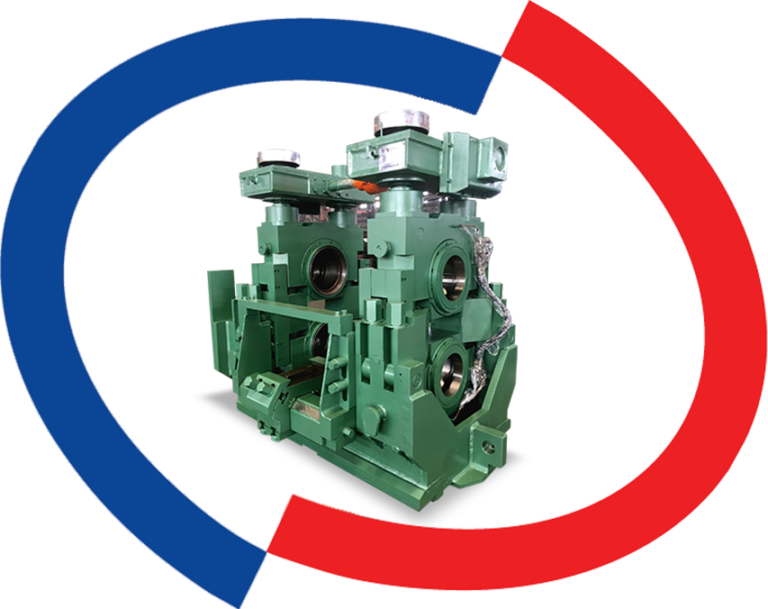
A mill stand carries the full rolling load of a hot rolling mill — every pass, every shift, for years without failure being an option. When a plant evaluates a new supplier, the question isn’t just what the stand costs; it’s how it was actually built, because that manufacturing process is what determines whether the stand holds tolerance under repeated high-load cycles or develops play and misalignment within a few years.
Mill stand manufacturing is the process of converting raw material — cast iron, cast steel, or fabricated steel plate — into a finished housing and roll-assembly structure through pattern-making, casting or fabrication, precision machining, assembly, and load testing, following a sequence that determines the stand’s final rigidity and alignment accuracy.
The process a manufacturer follows directly determines the stand’s rigidity, alignment accuracy, and service life under continuous rolling loads.
This guide walks through how rolling mill stands are actually manufactured — material selection, the production process step by step, and the quality checks a stand must pass before it leaves the factory — so you know what to ask when evaluating a manufacturer.
This matters more for structural and TMT bar mills running continuous multi-shift production than it might for lighter-duty applications, because a stand here rarely gets a genuine break between passes. The manufacturing decisions made before a stand ever reaches the mill floor are what determine whether it holds tolerance through years of that duty cycle or begins drifting within its first eighteen months.
Why Manufacturing Quality Determines Mill Stand Lifespan
A mill stand’s job is to hold two rolls in precise alignment while resisting the separating force generated as steel passes between them — a force that runs into hundreds of tonnes on a structural or TMT bar mill. If the housing flexes even slightly under that load, roll alignment drifts, and the result shows up downstream as dimensional inconsistency in the finished bar.
This is why manufacturing quality isn’t a finishing-touch consideration — it’s structural. A stand cast with internal porosity, or machined without verifying squareness between the housing windows, may pass a basic visual inspection and still fail to hold tolerance once it’s under real rolling load for a few months.
The practical consequence shows up gradually rather than as a sudden failure, which is part of why it’s easy to underweight at the ordering stage. A stand with a marginal casting defect or slightly out-of-tolerance housing window typically performs acceptably for the first few months. Wear then accelerates at the point of weakness, roll alignment drifts a little further with every pass, and by the time it shows up as a quality problem in the finished bar, the root cause is buried months in the past — and far harder to trace back to a manufacturing decision than it would have been to catch with proper testing before dispatch.
Material Selection for Mill Stand Fabrication
The starting material determines both the manufacturing route and the stand’s long-term behavior under load.
Cast Iron vs Cast Steel vs Fabricated Steel
Cast iron housings are common on lighter, older mill designs — they’re straightforward to produce in a single-piece pour but carry more risk of internal casting defects and generally lower toughness than cast steel. Cast steel housings, used widely on modern roughing and intermediate stands, offer significantly better toughness and resistance to shock loading, which matters when a mill trips or an oversized billet enters the pass. Fabricated steel housings — welded from forged steel plate rather than cast in one piece — skip the pattern-and-mold stage entirely, which shortens lead time and avoids casting-related defects, at the cost of requiring precise weld sequencing to control distortion.
The choice isn’t purely a cost decision. A roughing stand absorbing the highest separating forces in the mill is generally better served by cast steel’s toughness, while a finishing stand — handling lighter loads but requiring tighter dimensional accuracy — can sometimes be well served by a fabricated design if weld quality and stress-relief are properly controlled. Reputable manufacturers select the route based on the stand’s position in the rolling sequence, not a single default material across the whole mill.
Closed-type housings, cast as a single rigid frame, are generally specified for heavy roughing stands where maximum stiffness matters most. Open-type housings, with a removable top cap, trade a small amount of rigidity for significantly faster roll-change time — a relevant factor for mills running frequent product changeovers.
The Manufacturing Process Step-by-Step
Regardless of material route, a mill stand goes through the same broad sequence before it’s ready to ship.
Pattern-Making & Casting (or Fabrication)
For cast housings, a pattern is produced first — traditionally in wood or resin, increasingly via CAD-driven pattern design — and used to create the sand mold the housing is poured into. For fabricated housings, forged steel plates are cut to profile and prepared for welding according to a controlled sequence designed to minimize distortion.
Stress Relief
Both cast and welded housings carry internal stresses from the casting or welding process itself — stresses that, left unaddressed, release slowly over time and cause dimensional movement after the stand is already machined and in service. Heat-treatment stress relief before machining is what prevents this, and it’s a step that’s straightforward to skip under time pressure but difficult to detect until the stand is already installed and drifting.
Machining & Precision Boring
Once the rough casting or weldment has stress-relieved, it moves to machining, where the critical surfaces are cut to final dimension: the housing windows that locate the roll chocks, the base mounting faces, and the bores for adjustment screws. This is the stage where tolerance is actually created — a housing window bored even a fraction of a millimeter out of parallel will show up as uneven roll wear later.
Assembly & Fitting
Roll chocks, adjustment mechanisms, and bearing housings are fitted into the machined stand and checked for free movement without play. On stands with screw-down or hydraulic adjustment, this stage also confirms the adjustment mechanism moves through its full range without binding.
Quality Checks & Testing Before Dispatch
A mill stand that looks correct on the shop floor still has to prove it under conditions that approximate actual rolling load before it’s cleared for dispatch.
Dimensional Accuracy Checks
Housing window parallelism, base flatness, and bore alignment are verified against drawing tolerances using coordinate measuring or precision gauging — not just a visual and tape-measure check. For stands manufactured for TMT bar and structural mills, this verification directly determines whether the finished bar will meet dimensional tolerance once the stand is installed.
Material & Load Testing
Cast components are checked for internal defects — porosity, shrinkage cavities, or cracks — typically through ultrasonic or dye-penetrant testing on critical load-bearing sections. Material certificates confirming the correct grade and heat treatment should accompany every stand, and a reputable manufacturer will provide these without being asked.
Some manufacturers go further and simulate service load on a test rig before dispatch, checking for deflection under a controlled force approximating the stand’s rated separating force. This isn’t universal practice — it adds time and cost to the manufacturing cycle — but for a Tier-1 structural component like a roughing stand, it’s the closest a buyer can get to proof of performance before the stand is actually installed and running production.
What to Ask Your Mill Stand Manufacturer Before Ordering
Before finalizing an order, ask specifically: what material grade and casting or fabrication method is used for this stand type, what dimensional tolerances are held on the housing windows, and what testing (ultrasonic, dye-penetrant, load testing) is performed before dispatch. A manufacturer with a mature quality process will have specific, documented answers to all three — vague reassurance is itself a signal worth noting.
It’s also worth asking how the manufacturer’s stand design interacts with your specific mill stand configuration — housingless designs are manufactured and machined differently from conventional closed housings, and a supplier experienced with both will be able to explain the trade-off for your application rather than defaulting to whichever they build most often.
| Question | What a Strong Answer Looks Like |
|---|---|
| Material grade & route | Specific grade (e.g., cast steel to a stated specification) with a documented reason for the choice given your mill type |
| Dimensional tolerance held | Numeric tolerance figures for housing window parallelism and bore alignment, not “high precision” |
| Pre-dispatch testing | Named tests performed (ultrasonic, dye-penetrant, load test) with certificates provided as standard |
| Lead time & capacity | A specific timeline tied to your stand configuration, not a generic range |
Understanding how a mill stand is actually manufactured changes the conversation with a supplier from “what does it cost” to “what am I actually getting for that cost.” The stands that hold tolerance for years under continuous rolling load are the ones where material selection, machining precision, and pre-dispatch testing were treated as engineering requirements, not finishing steps. That’s the standard worth asking every mill stand manufacturer to meet.
Frequently Asked Questions
What material is best for rolling mill stand housings?
It depends on the application. Cast steel offers the best combination of toughness and rigidity for most roughing and intermediate stands, while fabricated steel housings can offer shorter lead times for certain configurations. Cast iron is still used on lighter or older mill designs but generally offers lower shock resistance than cast steel.
How long does it take to manufacture a mill stand?
Lead time depends on the housing type, size, and whether it’s cast or fabricated. Cast housings typically require longer lead times due to pattern-making and casting stress-relief, while fabricated housings can sometimes be produced faster since they skip the mold stage entirely.
What quality tests should a mill stand pass before dispatch?
At minimum, dimensional accuracy checks on housing windows and mounting faces, plus material integrity testing — ultrasonic or dye-penetrant inspection — on critical load-bearing sections. Material certificates confirming grade and heat treatment should be provided with every stand.
Why do some mill stands lose alignment after a few years of use?
This is usually traced back to the manufacturing stage rather than operational wear alone — internal casting defects, insufficient stress-relief before machining, or housing windows machined outside tolerance all show up over time as drift in roll alignment under sustained load.
Does Steefo manufacture custom mill stands for specific mill configurations?
Yes. Steefo designs and manufactures mill stands — including housingless and conventional configurations — matched to a plant’s specific rolling requirements. Contact our engineering team with your mill configuration for a tailored specification.
Get in Touch
To discuss a mill stand manufacturing specification for your rolling mill, see how our stands are engineered on the mill stands product page, read more on what sets our stands apart in The Steefo Advantage: Mill Stands Built to Last, or reach out to our team directly. Call us at +91 98240 76873 or write to marketing@thesteefogroup.com.