
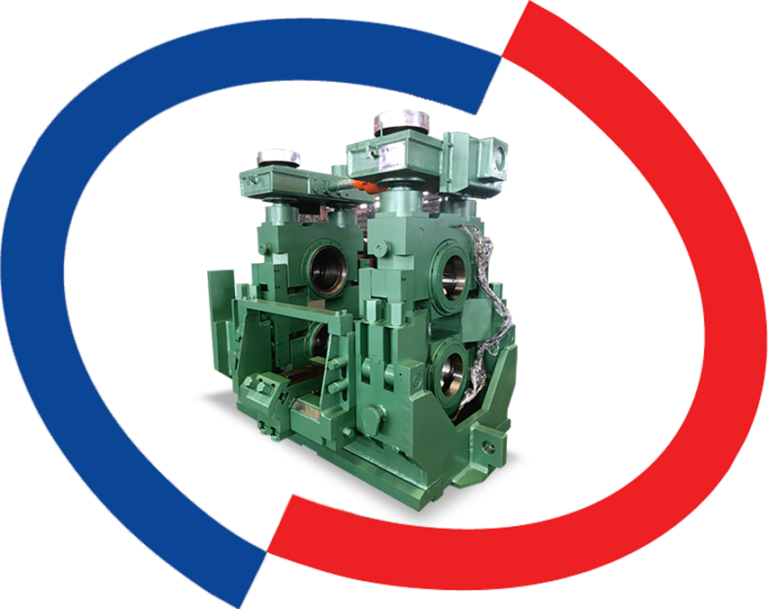
Walk down the line of a bar mill and every stand looks broadly alike: a housing, a pair of rolls, a spindle coming in from the drive. Yet the stand at the front of the mill and the stand at the back are doing very different jobs, and a plant that specifies them as if they were interchangeable usually pays for it later in broken rolls, unstable dimensions or constant stand changes. Understanding the roughing vs finishing mill stand distinction is the first step to specifying a rolling line properly.
The difference between roughing and finishing mill stands is the job each performs in the rolling sequence. Roughing stands take a hot billet through the first and heaviest reductions at low speed and very high load, while finishing stands make the last light reductions at high speed to deliver the final size, shape and tolerance. Intermediate stands bridge the two.
Nothing in that definition is complicated, but the consequences are. Each position in the train puts a different kind of stress on the stand, the drive and the rolls, and the design priorities change with it. This guide walks through the rolling sequence stand by stand, explains what each stage demands from the equipment, and finishes with the questions plant owners, engineers and procurement teams should ask a manufacturer before ordering.
The Rolling Sequence at a Glance
In a hot bar or section mill, a reheated billet passes through three groups of stands in order: the roughing train, the intermediate train and the finishing train. The bar is then cut, cooled and bundled. Published descriptions of continuous bar mills cite billets from about 130 mm square up to 250 mm square for larger lines, and the job of the whole train is to turn that thick, short piece of steel into a long, thin bar of exact dimensions.
Steel volume does not change as it is rolled, so every reduction in cross-section makes the bar longer. That single fact explains most of what follows. Take a 12-metre billet of 130 mm × 130 mm, which has a cross-section of 16,900 mm². A 16 mm round bar has a cross-section of roughly 201 mm². The same steel now stretches to about a kilometre in length, and it has to leave the last stand about 84 times faster than it entered the first. The front of the mill is slow, heavy and high-torque; the back is fast, light and precise. Every design difference between stands comes from that.
Most mills also alternate stand orientation, with horizontal stands followed by vertical ones, so the bar is squeezed from different directions without being twisted between passes. A rebar mill that Primetals Technologies announced for Pak Steel in 2021 shows the pattern clearly: a six-stand roughing train, a six-stand intermediate train and a four-stand finishing train, sixteen stands in all, built for an annual capacity of 450,000 tonnes. Your own mill may have fewer stands, but the logic is the same. Between the stands, roller table sections, guides and water boxes carry the bar from one pass to the next.
| Stage | Main Job | Rolling Speed | What Dominates the Design |
|---|---|---|---|
| Roughing | Break down the billet with large reductions | Lowest | Shock load, torque, structural strength |
| Intermediate | Bring the bar close to final section | Medium, rising | Balance of load and speed, flexibility |
| Finishing | Set final size, shape and tolerance | Highest | Dimensional accuracy, rigidity, fast changeover |
If you want the wider process picture, including reheating and cooling, our guide to the hot rolling mill process covers the full line. This article stays focused on the stands themselves.
Roughing Mill Stands
Role in the Sequence
The roughing mill in a steel plant is where the billet first meets the rolls, straight out of the reheating furnace and at its thickest. A roughing mill stand does the heavy lifting, taking large reductions per pass to turn a square billet into something much closer to the target proportions. The bar is still short and moving slowly, so the roughing stand in a rolling mill works at low speed but under the highest separating force and torque anywhere in the mill.
The front end of the bar is rarely clean, and the head and tail of a hot billet can be uneven. That is why crop shears are placed along the roughing section to trim the front and tail ends of the stock. Cobble shears sit ready to cut the bar up if a pass goes wrong. A roughing stand therefore has to survive the occasional bad entry, not just normal operation.
Design Priorities
Shock resistance and structural strength come first. A roughing stand sees the biggest load spike every time a billet bites, and a mis-fed or cold-ended billet makes that spike worse. Closed-type housings, cast or fabricated as a single rigid frame, are the usual choice for heavy roughing duty because they give the highest stiffness. Roll diameters are generally largest at this end of the line; published equipment specifications for re-bar mills commonly show diameters stepping down along the train, for example from around 560 mm in a roughing stand to around 410 mm in the first intermediate stands.
The drive line matters as much as the stand. Low speed and high torque mean a roughing stand relies on a robust reduction arrangement and well-matched rolling mill gearboxes, and an undersized drive shows up as stalled bars and cobbles rather than gradual wear. Because roughing rolls take the harshest treatment in the mill, serviceability matters more here than fine adjustment: this is where easy access and robust, repairable parts earn their keep.
Intermediate Mill Stands
Role in the Sequence
Intermediate stands take the roughed bar and reduce it, pass by pass, to a section that is near the final size. Loads are lower than in roughing, speeds are higher, and the bar is now long enough that it can span several stands at once. In a continuous mill that is where the line starts to behave as one connected machine, because each stand has to match the bar speed set by the one before it.
This is also the stage where mills gain or lose flexibility. On a plant that rolls several product sizes, the intermediate train is often where stands are added, bypassed or rearranged to suit the section being made. Published bar-mill layouts show intermediate trains split into groups, with stands that can be swapped to suit the range of finished sizes.
Design Priorities
An intermediate mill stand has to balance strength against speed. It needs enough rigidity to hold section accuracy as the bar gets smaller, but it also needs to run faster than a roughing stand without the stand and the bar misbehaving. Drive arrangement is a real design choice here: some mills drive stands in groups from a common motor, while others give individual stands their own drives for tighter speed control between passes.
Alignment and guide setup deserve particular attention. Small errors that go unnoticed in roughing are magnified as the bar gets thinner and faster, so intermediate stands reward accurate machining of housing windows and consistent roll chock fit. For that reason, how the stand was built matters as much as how it was specified.
Finishing Mill Stands
Role in the Sequence
The finishing mill stand is the last place the bar is shaped, and in practice it is where your customer’s tolerance is won or lost. Reductions here are light; the point is accuracy, not size reduction. The bar is long, fast and thin, and for TMT bar production it goes into the quenching and self-tempering section directly after the last stand, so whatever the finishing stand delivers is what the bar will be sold as.
Speeds in the finishing section can be very high. In wire rod mills, finishing blocks of six, eight or ten stands on a common drive are the conventional layout, and published designs describe delivery speeds above 100 m/s for thin rod. Bar and TMT mills run far slower, but the principle holds: the finishing stands are the fastest, lightest-loaded and most accuracy-sensitive in the line. A long, fast bar also needs the stand to hold alignment under vibration, since any looseness shows up directly as dimensional variation.
Design Priorities
Rigidity and repeatability lead the list. Finishing stands are where housingless mill stands make the strongest case. A pre-stressed housingless design limits roll spring-back, keeps the roll gap steady under load and allows a complete roll cartridge to be swapped quickly, which shortens the downtime of a changeover. Because size changes and roll wear show up first at the finishing end, fast stand changing tends to pay back here more than anywhere else in the mill.
Downstream equipment is tied to the finishing stand too. Once the bar leaves the last stand it is divided to length by a flying shear before it reaches the cooling bed, so the finishing section, the shear and the quenching line have to be specified as one sequence rather than three separate purchases.
Roughing vs Finishing Mill Stand: How Stand Design Changes Across the Sequence
Put the three stages side by side and the pattern is clear. Down the whole rolling mill stand sequence, load falls, speed rises and the price of an error shifts from broken equipment to out-of-tolerance product.
| Design Factor | Roughing Stand | Intermediate Stand | Finishing Stand |
|---|---|---|---|
| Typical load per pass | Highest | Moderate | Lightest |
| Rolling speed | Lowest | Rising | Highest |
| Frame preference | Heavy closed-type housing for stiffness | Conventional or housingless, depending on product range | Housingless or high-rigidity frames for accuracy and quick change |
| Drive emphasis | Torque and shock capacity | Speed matching between passes | Speed stability and fine control |
| Main failure risk | Cobbles, broken rolls, overload | Alignment drift, uneven wear | Dimensional variation, rapid guide wear |
| What buyers should prioritise | Strength and serviceability | Flexibility and machining accuracy | Rigidity and changeover speed |
This classification works along a different axis from the one used to describe roll configuration. Two-high, three-high or four-high layouts, and conventional versus housingless frames, describe how a stand is built, and we cover them in our guide to the key components of mill stands. Roughing, intermediate and finishing describe where a stand sits in the line. A real specification needs both answers for every stand.
What to Ask Before Specifying Stands for Each Stage
Most mistakes in stand selection come from specifying the whole train from a single template. These questions help a plant owner, engineer or procurement lead keep each stage honest:
- What billet size and steel grade will the roughing stand actually see? A mill planned around a larger billet needs more roughing capacity than the same product rolled from a smaller one.
- What is the full product range? The smallest and largest finished sizes decide how many stands are needed and which ones must be easy to swap.
- What is the target output in tonnes per hour? Output sets the speed the finishing stands must sustain.
- Which stands need housingless designs and which can stay conventional? The answer is rarely the same for every stand.
- How long does a stand or roll change take at each position? Changeovers tend to happen most often at the finishing end, so they deserve the closest attention.
- What spares will be held for each stage? Wear parts at the front of the mill are very different from those at the back.
The Steefo Group designs and manufactures conventional, housingless and HV (horizontal-vertical) mill stands for hot rolling lines, built around the product range and output of each plant rather than a single catalogue size. If you are planning a new line or upgrading an existing one, our engineering team can help you match stand type and drive to each stage of the train. You can see the full range on our mill stands page or contact the team with your billet size and product range.
The roughing vs finishing mill stand question is really a question about where stress lands in the line. Roughing stands absorb the shock and torque of heavy reductions, intermediate stands carry the bar to near-final size while balancing load and speed, and finishing stands protect accuracy at the highest speed in the mill. Plants that specify each stage for the job it actually does, and not as a copy of the stand next to it, spend less time on unplanned stoppages and hold tolerance far more reliably.
Frequently Asked Questions
What is the difference between roughing and finishing mill stands?
Roughing stands make the first, heaviest reductions on a hot billet at low speed and very high load. Finishing stands make the final light reductions at the highest speed to set the product’s size, shape and tolerance. Intermediate stands sit between the two and bring the bar close to its final section.
How many stands are in a typical roughing, intermediate and finishing train?
It depends on billet size, product range and output. One published rebar mill design pairs a six-stand roughing train with a six-stand intermediate train and a four-stand finishing train. Smaller re-rolling mills usually use fewer stands, and larger or multi-product lines use more.
Why do rolling mills alternate horizontal and vertical stands?
Alternating horizontal and vertical stands squeezes the bar from different directions without twisting it between passes. This keeps the section stable, allows larger reductions and reduces wear on guides, which is why many housingless and HV stand arrangements are used in modern bar mills.
Can the same mill stand design be used for roughing and finishing?
Not usually. Roughing stands need heavy frames and drives built for shock and torque, while finishing stands need rigidity, repeatable alignment and fast changeover at high speed. Using one design for both tends to compromise one end of the line, and a stage-by-stage specification is the safer approach.
Does Steefo supply mill stands for every stage of a rolling line?
Yes. Steefo designs and manufactures conventional, housingless and HV mill stands, matched to the billet size, product range and output of each plant. Share your mill details with our engineering team and we will recommend the stand type and drive arrangement for each stage.
Get in Touch
To discuss stand selection for your roughing, intermediate or finishing train, call us at +91 98240 76873 or write to marketing@thesteefogroup.com.