
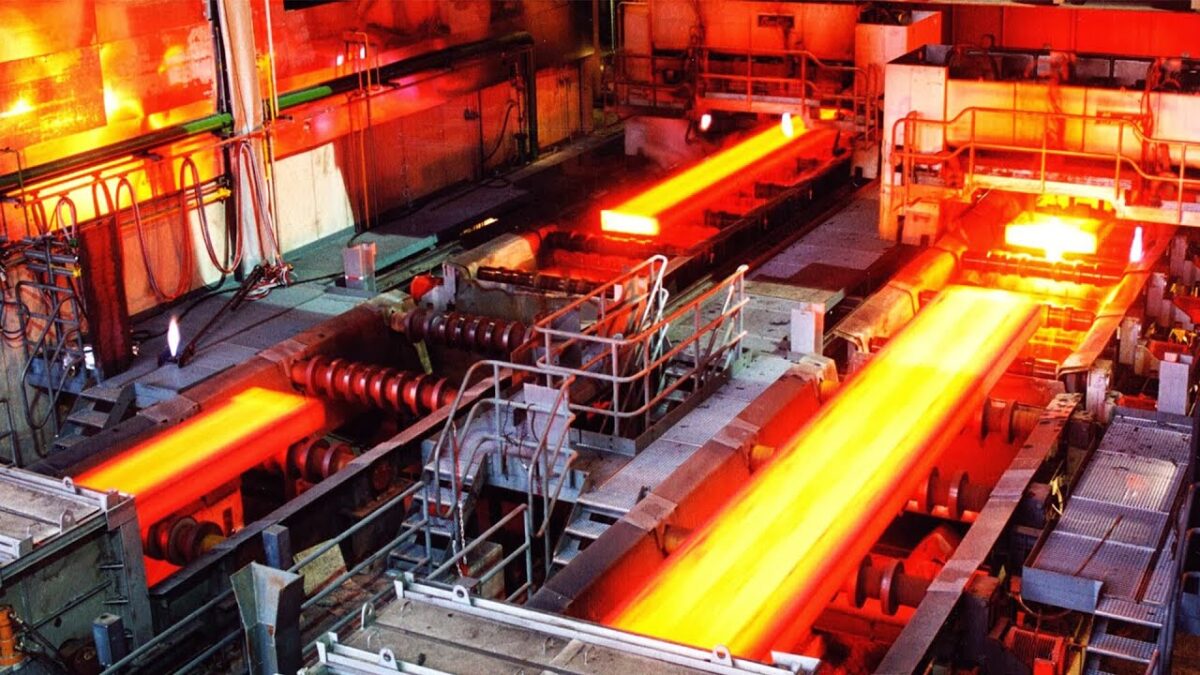
Steel doesn’t leave a rolling mill in the same size or shape it enters as. Somewhere between a red-hot billet coming out of the furnace and a finished bar, beam, or coil ready for dispatch, a hot rolling mill does the actual work of turning raw steel into a usable product. Understanding the hot rolling process – what actually happens at each stage, which equipment does what, and why hot rolling gets chosen over cold rolling for so many products – matters whether you’re specifying a new plant, evaluating a supplier, or simply trying to understand what your own mill is doing. This guide walks through the process end to end, the equipment involved, and where hot rolling fits among the different types of hot rolling mills in use today.
The hot rolling process heats steel billets or blooms above their recrystallization temperature – typically above 1,100°C – then passes the metal through a series of rollers that reduce its cross-section and reshape it into bars, rods, beams, or coils. Because the steel stays soft and workable throughout, hot rolling can reshape large sections without the high forces cold rolling would require.
How Does the Hot Rolling Process Work? (Step-by-Step)
A hot rolling mill doesn’t perform one action on the steel – it moves the material through a sequence of distinct stages, each doing a specific job before the next one starts:
- Reheating – billets or blooms are heated in a reheating furnace to above 1,100°C, the point at which steel becomes soft enough to deform without cracking or losing its underlying grain structure.
- Descaling – high-pressure water jets strip the oxide scale that forms on the steel’s surface during reheating. Skipping this step embeds scale into the surface during rolling, which shows up as visible defects on the finished product.
- Roughing (primary rolling) – the heated billet passes through the first set of mill stands, where the bulk of the cross-section reduction happens. This is where a billet starts looking like a rough version of its final shape.
- Intermediate rolling – additional stands continue reducing the cross-section and refining the shape, preparing the material for the tighter tolerances of the finishing stage.
- Finishing rolling – the final stands bring the product to its exact target dimensions and profile, whether that’s a TMT bar, structural section, or wire rod.
- Cooling – the rolled product passes across a cooling bed, where the cooling rate gets controlled deliberately, since cooling too fast or too slow changes the steel’s final grain structure and mechanical properties.
Each of these stages depends on the one before it running correctly. A furnace that doesn’t reach uniform temperature creates rolling problems two or three stages later that have nothing to do with the mill stands themselves – which is exactly why hot rolling mill design treats these stages as one connected system rather than six separate machines.
What Equipment Is Used in a Hot Rolling Mill?
Each stage above runs on specific, purpose-built equipment – understanding what each piece does makes it much easier to evaluate a mill design or diagnose where a bottleneck is actually coming from.
The reheating furnace brings billets up to rolling temperature before anything else can happen; furnace design and fuel efficiency directly affect both product quality and operating cost, since every degree of uneven heating shows up later as inconsistent rolling behavior.
Mill stands – arranged as roughing, intermediate, and finishing stands – house the rolls that actually reduce the steel’s cross-section at each stage. Modern mills increasingly use housingless mill stands for faster roll changes and easier maintenance access compared to older conventional housed designs.
Shears cut the material to length at various points in the process – some cut the leading and trailing ends during rolling (crop and cobble shears), while others divide the finished product to commercial length once rolling is complete.
Pinch rollers and loopers manage tension and material flow between stands, preventing the steel from either dragging back on itself or running ahead faster than the next stand can handle it.
Once rolling and cutting are done, the product moves across automatic cooling beds, where controlled cooling sets the final mechanical properties before the material is tied, bundled, and prepared for dispatch.
None of this equipment works in isolation. A furnace sized correctly for a plant’s target throughput, mill stands matched to the product mix, and shears rated for the line’s finishing speed all have to work as one coordinated system – which is why equipment selection for a new hot rolling mill typically starts with the target product and capacity, then works backward to the specific machinery each stage needs.
Hot Strip Mill vs Other Hot Rolling Mill Types
Not every hot rolling mill produces the same kind of product, and the term “hot rolling mill” covers several genuinely different mill configurations.
A hot strip mill is built specifically to roll flat products – steel slabs get reduced into thin, wide strips or coils, typically for sheet steel used in automotive, appliance, and general fabrication applications. The rolling sequence and stand configuration in a hot strip mill differ meaningfully from a bar or section mill, since the goal is width and thickness control across a flat, wide product rather than a round or profiled cross-section.
TMT bar mills, by contrast, are configured to produce reinforcement bars for construction, with quenching and self-tempering systems added after the finishing stands to achieve the strength and ductility combination TMT bars are known for.
Structural mills roll beams, channels, and angles – shapes that need precisely controlled flange and web dimensions rather than a simple round or flat cross-section.
Wire rod mills run at much higher finishing speeds than bar or structural mills, since wire rod is coiled continuously rather than cut to fixed lengths, which changes the pinch roller, looper, and coiling equipment needed downstream.
The core hot rolling principle – heat, then reduce cross-section through a sequence of stands – stays the same across all of these. What changes is the stand configuration, auxiliary equipment, and finishing process built around that principle for the specific product each mill type is designed to produce.
Why Is Hot Rolling Preferred?
Steel producers default to hot rolling for most primary steel production, and the reason comes down to what happens to steel above its recrystallization temperature. At that temperature, steel deforms plastically without work-hardening, meaning the mill can achieve large shape and size changes in a single pass that would require far more force – and far more expensive equipment – if attempted cold.
The steel that comes out of a hot rolling mill also carries a specific set of properties: it tends to be tougher, more ductile, and better able to absorb shock and vibration without cracking, compared to steel that’s never been through a hot deformation process. Those properties matter directly for structural steel, reinforcement bars, and other products that need to handle real mechanical stress in service, not just meet a dimensional spec on paper.
What Are the Advantages of Hot Rolling?
Beyond the core reason producers choose hot rolling, several specific advantages compound across a full production run:
Mechanical properties improve measurably. Elasticity, elongation percentage, shock resistance, and overall toughness all increase as the steel passes through the hot rolling process, since the heat and pressure actively refine the metal rather than just reshaping it.
The grain structure refines noticeably. Hot rolling breaks down the coarse grain typical of as-cast steel into finer, more uniform grains, which directly improves the steel’s strength and consistency.
Porosity drops out of the equation. Hot rolling closes internal voids left over from the casting process, producing a denser, more uniform final structure.
Impurities end up distributed evenly rather than concentrated in isolated pockets, which would otherwise create localized weak points prone to cracking. Slag and similar impurities spread through the material as it passes through the rolls.
Energy requirements stay comparatively lower. Because steel deforms far more easily above its recrystallization temperature, hot rolling needs less mechanical force per unit of shape change than cold rolling would to achieve the same result, which translates directly into lower energy consumption per tonne processed.
Is Hot Rolling Mill Automation Available?
Modern hot rolling mills run on considerably more automation than mills built even a decade ago. PLC-based control systems now manage furnace temperature profiles, roll gap settings between stands, and shear timing, which reduces the amount of manual adjustment needed to hold consistent dimensional tolerances across a full production run.
Automation matters most at the handoff points between stages – the furnace-to-mill transfer, stand-to-stand tension control through pinch rollers and loopers, and the shear timing that determines cut-to-length accuracy. Manual control at these points depends heavily on individual operator skill and reaction time; automated control holds the same tolerance shift after shift, which is a large part of why automation investment tends to pay back through consistency rather than raw speed alone.
Conclusion
Hot rolling remains the starting point for most steel production because it does something cold rolling simply cannot do as efficiently: reshape large, thick sections while the steel is still workable, without requiring the enormous force cold deformation would demand. Understanding the stages – reheating, descaling, roughing, intermediate rolling, finishing, and cooling – along with the equipment behind each one, makes it much easier to evaluate a mill design, specify new equipment, or diagnose where an existing line is underperforming.
The Steefo Group has been engineering hot rolling mill equipment since 1976, and holds ISO 9001:2015 certification alongside recognition as a Star Export House by the Government of India. With installations across more than 100 locations and rolling mill capacities ranging from 8 TPH to 100 TPH, Steefo’s equipment – reheating furnaces, mill stands, shears, and cooling systems – covers every stage of the hot rolling process described above.
Frequently Asked Questions
What is a hot rolling mill?
A hot rolling mill is an industrial facility that processes steel at high temperatures to reduce its thickness and reshape it into forms like bars, rods, beams, or coils. A series of rollers compresses the heated, malleable metal into the required profile.
What is the hot rolling process?
The hot rolling process involves heating steel above its recrystallization temperature – usually above 1,100°C – then passing it through a sequence of rollers to reduce thickness and change shape, producing a uniform, refined grain structure suitable for construction, automotive, and manufacturing applications.
What is a hot strip mill?
A hot strip mill is a hot rolling mill built specifically for flat products, reducing steel slabs into thin, wide strips or coils used for sheet steel in automotive, appliance, and fabrication applications. Its stand configuration differs from bar or structural mills, which are built around round or profiled cross-sections instead.
What equipment is used in a hot rolling mill?
A hot rolling mill relies on a reheating furnace, mill stands (roughing, intermediate, and finishing), shears for cutting to length, pinch rollers and loopers for tension control, and cooling beds to set the final mechanical properties before dispatch.
What is the difference between hot rolling and cold rolling?
Hot rolling is performed above the steel’s recrystallization temperature, making the metal easier to shape and better suited to large cross-section reductions. Cold rolling is done near room temperature, producing a smoother surface finish and tighter tolerances through strain hardening. A full comparison is available in Steefo’s hot rolling vs cold rolling guide.
What are the advantages of hot rolling steel?
Hot rolling improves mechanical properties, refines grain structure, eliminates porosity, distributes impurities evenly, and requires comparatively lower energy input than cold rolling to achieve the same shape change – making it the preferred method for large structural and reinforcement products.
Why is surface descaling important before hot rolling?
Descaling removes the oxide layer that forms on steel during reheating. Left in place, that scale gets pressed into the surface during rolling, causing visible defects and increasing wear on the mill rolls themselves.
Is a hot rolling mill fully automated?
Modern hot rolling mills use PLC-based automation to control furnace temperature, roll gap settings, and shear timing, which holds tighter, more consistent tolerances than manual operation. Automation is now standard at the handoff points between stages, though the degree of automation varies by mill design and budget.
Looking to Set Up or Upgrade a Hot Rolling Mill?
Whether you’re specifying a new hot strip mill, TMT bar line, or upgrading the equipment inside an existing plant, getting the furnace-to-cooling-bed sequence right from the start avoids problems that are expensive to fix later. The Steefo Group has engineered hot rolling mill equipment and turnkey plants since 1976, across capacities from 8 TPH to 100 TPH. Contact Us to talk through your specific requirement.