
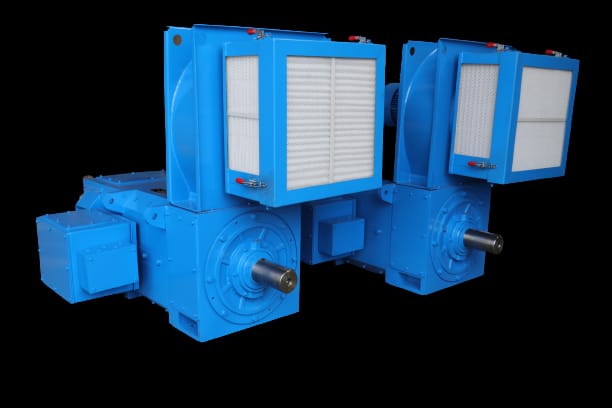
Hot rolling mills do not give motors an easy life. They run under heavy load, repeated speed changes, vibration, scale, heat, and continuous production pressure. In that environment, choosing DC motors is not only a question of motor size or horsepower. It is a process decision that affects rolling speed, torque stability, product quality, downtime, and long-term operating cost. In heavy industrial settings, the load’s speed and torque requirements must drive the motor choice, not the other way around.
A Quick Look:
The right DC motors for hot rolling mill applications should be selected based on torque requirement, rolling speed range, load fluctuations, duty cycle, overload capacity, drive compatibility, cooling arrangement, and maintenance needs. A correctly selected motor helps maintain stable rolling performance, reduce breakdowns, and improve production consistency.
Why DC Motors Are Used in Hot Rolling Mill Applications
DC motors remain relevant in hot rolling mills because they are well-suited to applications that need high starting torque, fast response, and precise speed control. A key benefit of industrial DC motors is their ability to separately regulate armature and field currents, allowing better control over torque performance and speed response under varying load conditions. This supports strong torque performance, including torque at low speeds and rapid response to changing load conditions, making these motors suitable for heavy-duty steel plant operations.
In a rolling mill, the drive system must handle roughing stands, finishing stands, conveyors, shears, and other auxiliaries without losing control when the load changes suddenly. Torque and power are two of the most important factors in the rolling process. In a hot rolling mill, motor power is used for steel deformation, overcoming friction, handling transmission losses, and maintaining stable rolling operations. That is why motor selection should be treated as a critical engineering decision rather than a routine equipment purchase.
Start with the Rolling Mill Application, Not Just the Motor Rating
Motor selection should begin with the actual rolling process. A rolling mill for TMT bars has different requirements from a structural mill, wire rod mill, or section mill. The motor may be used on a roughing stand, intermediate stand, finishing stand, pinch roller, conveyor, or shear, and each position has a different duty profile. The material being rolled, rolling temperature, target output, and line speed all influence the motor choice.
That is why a motor rated highly on paper may still fail in the plant if it is not matched to the actual process. A hot rolling line is not a single machine; it is a system of stands, transfer equipment, and auxiliary units working together.
A rolling mill consists of interconnected roll stands and supporting equipment that handle rolling, material transfer, turning, shearing, transporting, cooling, cutting, and packing operations. The motor must be selected to support the performance requirements of this complete system.
Evaluate the Torque Requirement of the Rolling Mill
Torque is one of the most important selection factors for DC motors in a hot rolling mill. Proper motor sizing starts with torque, load inertia, and speed. A motor must deliver enough starting torque to move the load, enough running torque to sustain rolling, and enough peak torque to handle billet entry and sudden load changes without overheating or stalling.
Here is a simple way to think about it. If the motor can handle the average load but not the peak load, the mill may slow down during biting or strain during heavy passes. If the motor is oversized without an engineering need, the project may incur unnecessary cost and higher energy consumption. In rolling operations, underestimating torque can lead to speed drops, motor stress, and production interruptions, while overestimating can hurt efficiency and capital cost.
Torque Checklist for Rolling Mill DC Motor Selection
- Starting torque
- Continuous running torque
- Peak torque
- Torque during billet entry
- Torque during rolling passes
- Torque reserve for shock loads
- Torque behaviour under sudden load changes
Check the Required Speed Range and Speed Control Accuracy
A hot rolling mill needs stable speed control, especially when multiple stands are working together. DC drives are widely valued in hot rolling mill applications because they offer fast response, precise torque control, and stable low-speed performance. In continuous rolling operations, accurate stand speed control is essential for maintaining tension-free rolling and consistent product quality.
Speed fluctuation can affect bar quality, cause tension between stands, and disturb process consistency. This is especially important where loopers are used to maintain tension-free rolling between stands. In practice, the selected DC motors should support smooth acceleration, controlled deceleration, and stable speed under changing load conditions.
How does DC motor speed control affect rolling mill performance?
It helps maintain stable rolling speed, reduce sudden speed drops, improve process control, and support consistent output quality in hot rolling mill operations.
Match the DC Motor with the Rolling Mill Load Profile
A rolling mill rarely behaves like a constant-load machine. Some sections run under heavy starting load, some under variable load, and some under intermittent conditions. The motor must be selected for the real load profile, not just the nameplate power. The torque-speed characteristic must match the type of load the motor will drive.
This is where many selection mistakes happen. A roughing stand may demand very different behaviour from a finishing stand or a shear. Load changes between passes can also create torque spikes. If those changes are not considered, the motor may overheat or fail to hold speed.
Why is the load profile important in DC motor selection?
It shows how the motor will perform during starting, running, overload, and sudden load changes. In hot rolling mills, an incorrect load assessment can cause overheating, poor speed control, and frequent breakdowns.
Consider Duty Cycle and Continuous Operation Requirements
Many industrial DC motors in rolling mills operate for long periods and may face repeated start-stop cycles. Most motors used in industrial applications are rated for continuous-duty operation, and their temperature and time ratings become critical at full load. In a hot rolling mill, that thermal reality matters because heat buildup can become a reliability problem if the motor is not properly sized and cooled.
The duty cycle should be checked against the plant’s actual production schedule. If the line runs continuously with frequent load spikes, the motor must support heavy-duty operation without losing thermal stability. If it only runs in short bursts, the selection logic changes. Continuous-duty and periodic load duty cycles require different drive sizing and motor selection approaches because the thermal and load demands vary significantly between operating conditions.
What duty cycle is suitable for DC motors in hot rolling mills?
DC motors used in hot rolling mills usually need to support heavy-duty or continuous-duty operation, depending on the production schedule, rolling load, start-stop frequency, and thermal conditions of the plant.
Check Power Rating, Voltage and Drive Compatibility
A motor should never be selected in isolation from its drive system. The motor and drive system should be selected based on the required speed range, torque demand, and operating conditions of the load. In a hot rolling mill, the selected DC motors must work efficiently with the plant’s drive system, control panel, voltage level, and automation setup to ensure stable and reliable performance.
For hot rolling mills, this means checking the motor power rating, rated voltage, armature and field requirements, drive compatibility, power supply stability, and room for future capacity expansion. A mismatch between motor and drive can reduce torque delivery, weaken speed control, or create reliability and safety issues.
Power and Drive Compatibility Table
|
What to check |
Why it matters |
Practical question |
| Power rating | Confirms the motor can carry the load | Can the motor handle the full rolling load? |
| Voltage | Prevents electrical mismatch | Does the motor match the plant supply and drive output? |
| Drive compatibility | Ensures stable speed/torque control | Will the drive and motor work as a matched pair? |
| Control integration | Supports smooth operation | Can the motor be monitored and controlled reliably? |
| Expansion room | Helps future-proof the line | Will the motor still suit higher production later? |
Review Cooling, Ventilation and Rolling Mill Environment
Hot rolling mills are harsh environments. Heat, dust, moisture, scale, and vibration can all affect motor life. That is why motor selection must consider not only electrical ratings but also the physical conditions around the machine. Hot rolling mills operate under high ambient temperatures, continuous production pressure, scale, dust, moisture, and vibration. These conditions can significantly affect motor life and performance if the motor is not properly selected for the operating environment.
In a hot rolling environment, the cooling method and enclosure type become important. If ventilation is poor or contamination is high, the motor may age faster than expected. Selecting DC motors with the right protection and cooling arrangement helps maintain performance under steel plant conditions.
Consider Maintenance Access and Long-Term Serviceability
Even a technically correct motor can become expensive if it is difficult to maintain. In rolling mills, brushes, commutators, bearings, and windings should be easy to inspect and service. That matters because maintenance access affects uptime, planned shutdown efficiency, and the cost of ownership.
In rolling mills, brushes, commutators, bearings, and windings should be easy to inspect and service. That matters because maintenance access directly affects uptime, planned shutdown efficiency, and the overall cost of ownership. Long-term serviceability should therefore be considered an important part of the motor selection process.
For DC motors, maintenance planning should include brush inspection, commutator condition, bearing health, winding protection, and spare part availability. If service support is weak, a small fault can turn into a long production interruption. That is why good selection is not just about performance today; it is about support over the life of the plant.
What maintenance factors matter when selecting DC motors for rolling mills?
Important maintenance factors include brush and commutator access, bearing condition, cooling system inspection, winding protection, spare availability, and ease of servicing during planned shutdowns.
Avoid Selecting DC Motors Based Only on Price
A low initial price can be misleading. In a hot rolling mill, an undersized or poorly matched motor may lead to higher breakdown risk, more maintenance, energy loss, and production downtime. In hot rolling mills, focusing only on the initial purchase price can lead to higher long-term operating costs. Poorly matched or low-quality industrial DC motors may increase the risk of breakdowns, energy losses, frequent maintenance, and production downtime over time.
The better question is not “What is the cheapest motor?” It is “What motor will deliver the required torque, speed stability, reliability, and service life at the lowest total cost over time?” In rolling mills, that mindset protects both production and profitability.
Questions to Ask Before Finalising DC Motors for a Rolling Mill
Before finalizing the motor selection, it is important to evaluate the following technical and operational questions:
- What is the required starting torque?
- What is the continuous operating torque?
- What is the expected speed range?
- Will the motor handle frequent load fluctuations?
- What is the duty cycle?
- What overload capacity is required?
- What cooling method is suitable?
- Is the motor compatible with the existing drive system?
- What are the environmental conditions around the motor?
- How easy is the motor to maintain?
- Are spares and service support available?
- Will the motor support future capacity expansion?
Why Work with an Experienced Rolling Mill Manufacturer for DC Motor Selection
For hot rolling mills, DC motors should be selected as part of the complete mill design, not as a standalone purchase. The motor must match mill stands, gearboxes, shears, conveyors, automation, and the line’s speed and torque profile. A manufacturer with rolling mill experience can align the drive system with the actual process instead of relying on generic industrial assumptions.
That is especially important because rolling mills depend on coordinated equipment. In a hot rolling mill, the rolls are driven through an electrical drive system that includes the motor, gearbox, spindle, and couplings. The quality of the finished product depends on controlled reduction across multiple rolling passes and proper coordination between these components. Good engineering at the selection stage reduces downtime and improves reliability over the life of the plant.
Conclusion
The right DC motors for hot rolling mill applications are the ones that match the mill’s torque, speed, load profile, duty cycle, cooling, and control requirements. When selection is done properly, the result is better rolling stability, fewer breakdowns, improved product consistency, and stronger long-term operating performance. In a rolling mill, the motor is not just a component. It is one of the main drivers of output quality and plant efficiency.
Frequently Asked Questions (FAQs)
1. What type of DC motor is suitable for hot rolling mills?
DC motors used in hot rolling mills should provide high starting torque, stable speed control, overload capacity, and reliable performance under heavy-duty operating conditions. The right motor type depends on the rolling mill layout, production load, and process requirements.
2. Why is torque important in rolling mill DC motor selection?
Torque matters because rolling mills face heavy mechanical load during biting, deformation, and speed changes. If torque is insufficient, the motor may overheat, slow down, or fail under load.
3. How do speed fluctuations affect hot rolling mill output?
Speed fluctuations can disturb tension-free rolling, reduce process consistency, and affect bar quality. Stable speed control helps the mill maintain controlled production across multiple stands.
4. What should be checked before buying DC motors for rolling mills?
Check torque, speed range, duty cycle, voltage, drive compatibility, cooling, environmental protection, maintenance access, and spare support before finalising the motor.
5. Can a standard industrial DC motor be used in a hot rolling mill?
Not always. A standard motor may not have the torque reserve, thermal capacity, or serviceability needed for a hot rolling mill. The application must be matched carefully.
Select DC Motors That Keep Your Rolling Mill Running Strong
Need help selecting the right DC motors for your hot rolling mill? The Steefo Group offers engineering-driven rolling mill solutions designed for performance, reliability, and long-term productivity. If you are upgrading an existing line or planning a new one, the right motor choice can protect output quality, reduce downtime, and support smoother operations across the plant.
The best results come from matching the motor to the actual load, speed, cooling, and maintenance needs of the mill, not just the nameplate rating. With the right technical partner, motor selection becomes a strategic advantage rather than a sourcing challenge.
Talk to The Steefo Group at +91 87589 98607 or email us at marketing@thesteefogroup.com to select DC motors that match your rolling mill’s real production, performance, and reliability requirements.