
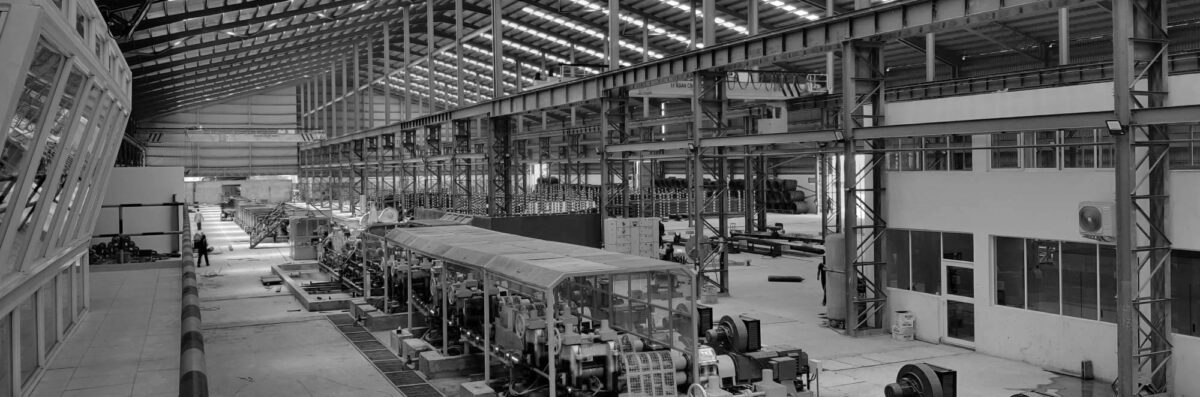
Ask five people in a steel plant what a rolling mill actually is, and most will point at the machine rather than explain the process. That’s fair – a rolling mill is fundamentally simple in principle even though the equipment behind it isn’t. This guide covers the meaning, how the process actually works, the different types of rolling mills in use today, and where a rolling mill fits inside a working steel plant.
What Is a Rolling Mill? (Meaning & Definition)
A rolling mill is a machine, or a connected set of machines, that reduces the thickness of a metal billet or slab by passing it between pairs of rotating rolls under pressure. The term also refers to the entire plant setup built around this process – the rolls, drive systems, and supporting equipment working together to convert raw steel into bars, rods, beams, sheets, or coils.
The metal doesn’t lose material during this process. A rolling mill squeezes the cross-section down while the material’s volume stays the same, which is why the steel gets longer and thinner rather than smaller overall. Depending on the metal’s temperature during rolling, the process is classified as either hot rolling (above the metal’s recrystallization temperature) or cold rolling (below it) – a distinction that shapes almost every other decision in how a rolling mill line gets designed.
How Does a Rolling Mill Work?
At a basic level, a rolling mill runs on the same principle regardless of scale: a heated or room-temperature billet passes between two or more rotating rolls, spaced closer together than the billet’s starting thickness. The rolls grip the material and pull it through, squeezing the cross-section down and pushing the length out.
A working hot rolling mill line adds several stages around that core action – reheating the billet, descaling its surface, then passing it through roughing, intermediate, and finishing stands before a controlled cooling stage sets the final properties. Steefo’s hot rolling mill process guide breaks down each of these stages in full detail, including the equipment used at every step.
What Are the Main Types of Rolling Mills?
Not every rolling mill produces the same product, and the equipment configuration changes depending on what’s being rolled.
TMT bar mills roll reinforcement bars for construction, with quenching and self-tempering systems added after the finishing stands.
Structural mills roll beams, channels, and angles, which need tightly controlled flange and web dimensions rather than a simple round cross-section.
Wire rod mills run at much higher finishing speeds than bar mills, since wire rod gets coiled continuously instead of cut to fixed lengths. Steefo’s wire rod mill guide covers how that changes the equipment involved.
Hot strip mills are built specifically for flat products, reducing steel slabs into thin, wide strips or coils used for sheet steel.
The core rolling principle stays the same across all four – heat where applicable, then reduce cross-section through a sequence of stands. What changes is the stand configuration and auxiliary equipment built around that principle for the specific product each mill type produces.
| Mill Type | Typical Product | Key Differentiating Equipment |
|---|---|---|
| TMT bar mill | Reinforcement bars for construction | Quenching and self-tempering system after finishing stands |
| Structural mill | Beams, channels, angles | Stands built for controlled flange and web dimensions |
| Wire rod mill | Continuously coiled wire rod | Higher-speed finishing block, continuous coiling equipment |
| Hot strip mill | Flat sheet and coil | Wide-format stands for width and thickness control |
A plant rarely needs more than one of these configurations, since the stand design, cooling setup, and finishing equipment are built around a specific product rather than general-purpose use. That’s part of why the mill type decision gets made early – retrofitting a bar mill’s stands and cooling bed to produce structural sections later is a far bigger project than specifying the right mill type at the outset.
Hot Rolling vs Cold Rolling: What’s the Difference?
Hot rolling happens above the steel’s recrystallization temperature, which keeps the metal soft enough to reshape large sections without the enormous force cold deformation would require. Cold rolling happens near room temperature, producing a smoother surface finish and tighter dimensional tolerance through strain hardening rather than heat.
Most primary steel production – bars, structural sections, plates – starts with hot rolling, since it’s the more efficient way to achieve large shape changes. Cold rolling then refines specific products further where surface finish and precision matter more than raw throughput. Steefo’s hot rolling vs cold rolling comparison goes through the full trade-offs between the two.
What Is a Rolling Mill Used for in a Steel Plant?
Inside a working steel plant, a rolling mill is the equipment that turns semi-finished casting output – billets, blooms, or slabs – into a sellable, usable product. Without it, a steel plant’s casting operation would only ever produce raw shapes with no commercial application on their own.
That makes the rolling mill division the point where a steel plant’s output actually becomes revenue. A plant’s product mix – whether it specializes in TMT bars, structural sections, wire rod, or flat sheet – gets determined largely by which type of rolling mill it operates. That’s why the mill selection decision at the design stage shapes a plant’s market position for years afterward.
The rolling mill also determines a plant’s practical capacity limits. A mill rated for 8 TPH and one rated for 100 TPH aren’t just different sizes of the same setup – they call for different furnace capacity, different stand strength, and different automation levels to run reliably at their respective throughputs. Sizing a rolling mill correctly against a plant’s realistic production targets, rather than the maximum capacity a vendor can technically build, is one of the more consequential decisions in a steel plant’s original design.
Conclusion
A rolling mill, at its core, does one job: reduce a metal’s cross-section by passing it between rotating rolls, without losing material in the process. Everything else – hot versus cold, TMT versus structural versus wire rod, the specific stages a billet moves through – is a variation built on top of that same core mechanism.
The Steefo Group has manufactured rolling mill equipment since 1976, holds ISO 9001:2015 certification and Star Export House recognition from the Government of India, and has supplied rolling mills with capacities ranging from 8 TPH to 100 TPH to plants across India and export markets including Bangladesh, Kenya, and Saudi Arabia.
Frequently Asked Questions
What does rolling mill mean?
A rolling mill is a machine or connected set of machines that reduces a metal’s thickness by passing it between rotating rolls under pressure, reshaping it into bars, rods, beams, sheets, or coils without losing material in the process.
What is a rolling mill in a steel plant?
In a steel plant, the rolling mill is the division that converts semi-finished casting output – billets, blooms, or slabs – into finished, sellable products. It’s the stage where raw cast steel becomes a usable commercial shape.
What is the rolling mill process?
The rolling mill process involves passing metal between rotating rolls to reduce its thickness and change its shape. For hot rolling specifically, this includes reheating, descaling, and multiple rolling stages before controlled cooling sets the final properties – covered in full in Steefo’s dedicated process guide.
What are the different types of rolling mills?
The main types include TMT bar mills, structural mills, wire rod mills, and hot strip mills, each configured with different stand arrangements and auxiliary equipment to suit the specific product – reinforcement bars, beams and channels, coiled wire rod, or flat sheet.
What is the difference between a rolling mill and a hot rolling mill?
“Rolling mill” is the general term for the equipment and process; “hot rolling mill” specifically refers to a rolling mill that processes steel above its recrystallization temperature, as opposed to a cold rolling mill, which operates near room temperature.
Who manufactures rolling mills in India?
Several manufacturers operate in India’s rolling mill industry. The Steefo Group has been manufacturing rolling mill equipment and turnkey plants since 1976, with installations across India and export markets, holding ISO 9001:2015 certification and Star Export House recognition.
Looking to Set Up or Upgrade a Rolling Mill?
Whether it’s a new TMT bar line, a structural mill, or an upgrade to an existing plant’s rolling division, getting the mill type and configuration right at the design stage avoids costly rework later. Steefo’s engineering team has specified rolling mills across capacities from 8 TPH to 100 TPH for plants in India and abroad. Contact Us to discuss what your plant actually needs.