
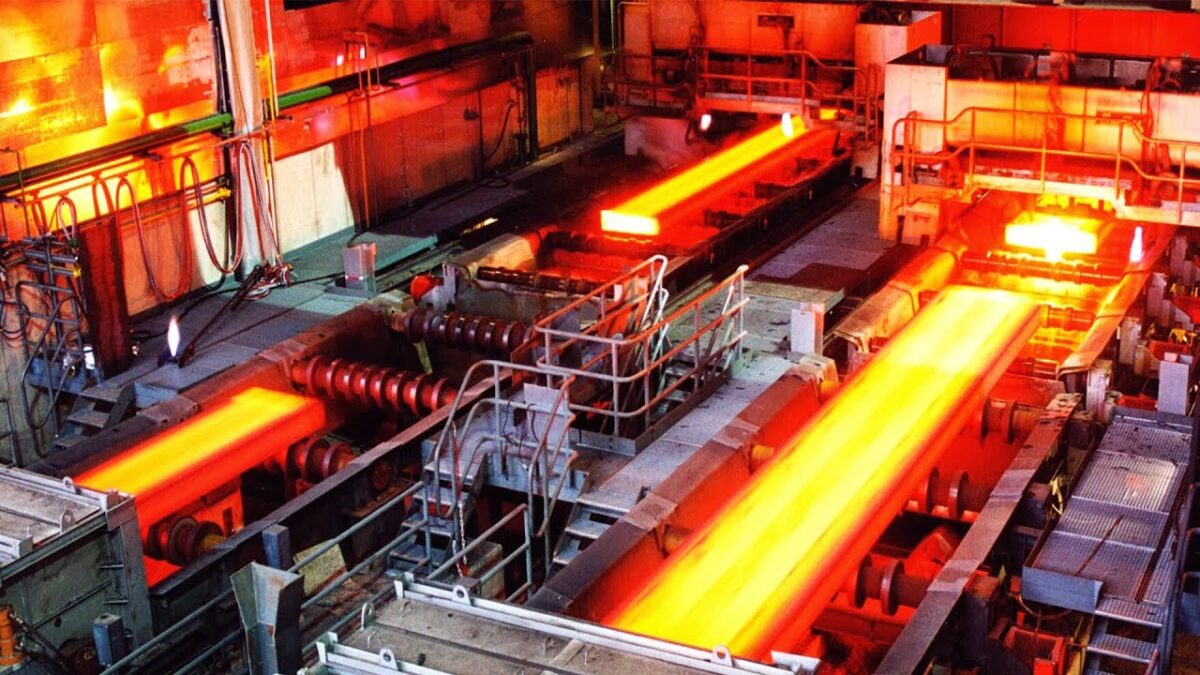
A finished steel bar does not come out of a steel plant in one step. It begins as a billet and then moves through heating, descaling, rolling, cooling, cutting, inspection, bundling, and dispatch. Every stage affects the next. That is why a rolling mill must be designed as a complete process, not as isolated machines.
Quick Answer:
In a rolling mill, a steel billet is heated, descaled, passed through roughing, intermediate, and finishing stands, shaped into the required bar size, cooled on a cooling bed, cut to length, inspected, bundled, and prepared for dispatch. Each stage controls the steel’s shape, surface quality, dimensional accuracy, and final usability.
For manufacturers, project consultants, and plant owners, this journey matters because it shows how steel quality is built step by step. The Steefo Group works in rolling mill and steel plant engineering with that full-process view in mind.
What Is a Billet in a Steel Plant?
A billet is a semi-finished steel product. It is usually square or rectangular in cross-section and is used to make long products such as bars, rods, flats, and structural sections.
In a rolling mill, the billet is the starting material. Its quality has a direct impact on the final bar. Chemical composition, surface condition, internal soundness, and dimensional consistency all matter. If the billet has defects, those issues can travel through the process and appear in the finished product.
That is why billet control is not a small detail. It is the foundation of the entire steel plant production flow.
Stage 1: Billet Inspection Before Rolling
The journey starts before heating. Every billet should be checked for size, grade, surface condition, and traceability. This first inspection helps confirm that the raw material is fit for rolling.
Typical checks include:
- Billet size and cross-section
- Grade verification
- Surface cracks or folds
- Bends or twists
- Excess scale or contamination
- Batch identification and traceability
This stage matters because a poor billet can create problems later in the line. No amount of precise rolling can fully compensate for a defective input. In a well-run rolling mill, billet acceptance is treated as a quality gate, not a formality.
For long-product manufacturers, this early control step helps reduce rejection, rework, and instability in production. It also supports consistency across batches, which is essential for every modern steel plant.
Stage 2: Reheating the Billet for Rolling
A billet must be heated before rolling so it becomes easier to deform. Steel that is cold is much harder to shape. When heated correctly, it becomes more plastic and can pass through the stands with less resistance.
The reheating furnace plays a major role here. It must deliver a uniform temperature across the billet. If the billet is heated unevenly, one section may roll differently from another. That can affect shape, surface quality, energy use, and mill productivity.
Good reheating supports:
- Lower rolling force
- Better deformation behaviour
- Reduced risk of cracking
- More stable mill operation
- Improved output consistency
In practical terms, reheating is where the billet becomes ready for transformation. The better the temperature control, the smoother the rest of the rolling mill process will be.
Stage 3: Descaling Before the Billet Enters the Rolling Stands
During billet heating, an oxide layer develops on the steel surface due to exposure to high temperatures. Scale is a natural oxide layer, but it should not stay on the billet surface before rolling. If it does, it can be pressed into the steel and affect the finish quality.
That is why descaling is an important step. It removes the scale before the billet enters the stands. This may be done through water descaling or other scale-removal methods, depending on the line design.
Poor descaling can lead to:
- Surface marks
- Rolled-in scale
- Rough finish
- Higher reject risk
- More cleaning issues later
This stage may look simple, but it has a strong effect on the final bar. In a well-designed rolling mill, descaling protects product quality before the main deformation begins.
Stage 4: Roughing Mill — The First Major Shape Change
The roughing mill is where the billet undergoes its first major transformation. Here, heavy-duty stands reduce the cross-section and increase the length. The steel begins moving away from billet form and toward bar form.
This stage handles major deformation. That means the equipment must be strong, aligned, and stable. Guides, drives, gearboxes, and roller systems all need to work together so the billet moves smoothly through the line.
The roughing mill is important because it:
- Breaks down the billet quickly
- Starts the elongation process
- Prepares the stock for later passes
- Reduces the cross-section in controlled steps
The first shape change is not the final one. It is the foundation for everything that follows in the rolling mill sequence.
Stage 5: Intermediate Rolling — Controlling Shape and Size
After roughing, the bar enters the intermediate stands. Here, the focus shifts from heavy reduction to control. The product continues to reduce in size, but now shape stability becomes more important.
This is where the bar gets closer to its target profile. The stands, guides, and pass design help maintain the correct movement and geometry. Speed coordination is also important because the bar must flow continuously without tension problems or misalignment.
Intermediate rolling helps with:
- Further cross-section reduction
- Better profile control
- Smoother transfer between stands
- Improved dimensional stability
- Preparation for finishing passes
This stage is often the bridge between strength and precision. In a properly engineered rolling mill, the process is steady before the final sizing stage.
Stage 6: Finishing Mill — Achieving the Final Bar Profile
The finishing mill is where the steel gets its final shape and size. This stage is responsible for dimensional accuracy, surface quality, and consistency. The product now moves into its market-ready profile.
Depending on the product being made, the finishing mill can produce:
- TMT bars
- Round bars
- Flats
- Squares
- Other long steel profiles
The finishing stands work with a precise roll pass design to deliver the required result. This is the stage where the bar becomes a finished product, not just a reduced section of steel.
The finishing mill must deliver:
- Final size control
- Consistent profile
- Good surface finish
- Stable line speed
- Uniform output quality
This is one of the most important stages in the entire rolling mill process because it defines the product that buyers see and use.
Stage 7: Quenching or Controlled Cooling for TMT Bars
This stage is used when the product is a TMT bar. After the final finishing stand, the hot bar passes through a controlled cooling or quenching system. The outer surface cools quickly, while the inner core stays hotter for a little longer.
That difference creates the strength-flexibility balance needed in TMT reinforcement bars. The surface gains higher hardness, while the inner core retains better flexibility and toughness. This is why TMT bars are widely used in construction.
Controlled cooling helps achieve:
- Strong outer surface
- Ductile inner core
- Better load performance
- Improved bendability
- Construction-grade reinforcement quality
Not every finished bar follows this exact path, but for TMT production, it is a key part of the rolling mill process.
Stage 8: Cooling Bed — Bringing the Bar to a Stable Temperature
After rolling or quenching, the bar is transferred to the cooling bed. Here, the product cools in a controlled way before later handling steps.
The cooling bed helps:
- Stabilise the bar temperature
- Reduce distortion
- Support straightness
- Maintain dimensional consistency
- Prepare the bar for cutting and bundling
This stage should not be treated as a waiting area. It is part of quality control. If the cooling is uneven or uncontrolled, the bar may twist, bend, or lose uniformity.
A good rolling mill line uses the cooling bed as a stabilising stage, not just a storage stage.
Stage 9: Cutting the Finished Bar to Saleable Lengths
Once the bar has cooled enough, it must be cut to saleable lengths. This can be done with hot shears during rolling or cold shear systems after cooling, depending on the process setup.
Cutting matters because buyers need standard lengths that are easy to transport, store, and use in fabrication or construction. Clean cutting also helps remove uneven ends and improves product handling.
This stage ensures:
- Correct saleable length
- Better dimensional accuracy
- Cleaner bundle formation
- Reduced waste and irregular ends
In a serious rolling mill, cutting is part of product finalisation, not just a finishing touch.
Stage 10: Inspection, Bundling and Dispatch
The last stage is inspection and dispatch. Finished bars are checked for surface condition, straightness, dimensions, and grade identification. Then they are counted, bundled, weighed, tagged, and prepared for storage or shipment.
Typical final checks include:
- Size and profile verification
- Surface inspection
- Straightness check
- Bundle counting
- Weighing and tagging
- Dispatch readiness
This stage completes the steel journey. By the time the bar leaves the plant, it should already be verified for quality and traceability. That is what turns a processed bar into a reliable commercial product from a modern steel plant.
Key Rolling Mill Equipment Used in the Billet-to-Bar Journey
| Equipment | Process Role |
Why It Matters |
| Reheating furnace | Heats the billet | Makes steel easier to roll |
| Descaling system | Removes surface scale | Improves surface finish |
| Roughing stands | First major reduction | Starts shape transformation |
| Intermediate stands | Controls size and flow | Improves profile accuracy |
| Finishing stands | Final shaping | Delivers final dimensions |
| Guides and rollers | Direct material flow | Maintain alignment |
| Pinch rollers | Support movement | Improve line control |
| Loopers | Manage tension and speed | Help smooth transfer |
| Gearboxes and drives | Power the stands | Support a stable rolling force |
| Shearing machines | Cut bars to length | Create a saleable product |
| Cooling bed | Stabilises hot bars | Helps straightness and quality |
| Bundling systems | Count and pack bars | Prepare for dispatch |
This equipment works as one line, not as separate units. That is why a rolling mill must be planned as an integrated system inside the steel plant.
What Determines the Quality of the Finished Bar?
A finished bar is only as good as the process that created it. Quality is not controlled by one machine alone. It comes from many decisions working together.
The main factors include:
- Billet quality
- Reheating temperature control
- Pass design
- Roll alignment
- Speed control
- Tension control
- Cooling method
- Cutting accuracy
- Maintenance discipline
- Operator skill
- Automation and monitoring
This is where experience matters. A quality rolling mill does not rely on guesswork. It relies on controlled process design, proper equipment matching, and disciplined operation.
Why Rolling Mill Design Matters in the Final Output
A rolling mill must be engineered as a connected production system. If the layout is weak, the line becomes slow or unstable. If the equipment is mismatched, the plant may face bottlenecks, maintenance issues, or uneven output.
A strong design improves:
- Production flow
- Output consistency
- Maintenance access
- Energy use
- Operator efficiency
- Plant reliability
That is why steel plant owners should think beyond individual equipment. The best results come from a line where the furnace, stands, drives, guides, shears, cooling bed, and automation all work together.
For The Steefo Group, this system-based approach is central to rolling mill and steel plant engineering.
Choosing the Right Rolling Mill in Ahmedabad
Ahmedabad is one of India’s important industrial and manufacturing hubs. For buyers searching for a rolling mill in Ahmedabad, the right choice should be based on more than machine supply.
A reliable partner should offer:
- Complete process understanding
- Customised or turnkey solutions
- Long-product engineering capability
- Support for TMT, bar, structural, and section projects
- After-sales service and spare support
- Flow design from billet to dispatch
The most important point is this: the right partner should understand the entire steel journey, not just one machine. When that happens, the rolling mill becomes a production advantage, not just a capital purchase.
Conclusion
The journey from billet to finished bar is a connected process. Every stage matters. Billet quality, heating, descaling, roughing, intermediate rolling, finishing, cooling, cutting, inspection, and bundling all shape the final result.
When the rolling mill is designed and operated properly, the output becomes more consistent, more usable, and more reliable. That is what steel buyers, plant owners, and project decision-makers need from a modern steel plant.
Frequently Asked Questions (FAQs)
1. What is the journey of steel in a rolling mill?
Steel begins as a billet and moves through inspection, heating, descaling, roughing, intermediate rolling, finishing, cooling, cutting, inspection, bundling, and dispatch.
2. What is the first step in the rolling mill process?
The first step is billet inspection and acceptance before heating.
3. Why is a billet heated before rolling?
A billet is heated so it becomes more plastic and easier to deform during rolling.
4. What is the role of roughing, intermediate, and finishing stands?
Roughing starts the main reduction, intermediate improves shape control, and finishing gives the bar its final profile and accuracy.
5. What equipment is used in a rolling mill?
A rolling mill uses a reheating furnace, descaling system, rolling stands, guides, drives, shears, cooling bed, and bundling equipment.
6. What affects the quality of finished steel bars?
Billet quality, temperature control, pass design, alignment, speed, cooling, cutting, maintenance, and operator skill all affect the final bar.
7. How do I choose a rolling mill manufacturer in Ahmedabad?
Choose a manufacturer with complete process knowledge, customised engineering capability, support services, and experience in long-product steel plant projects.
Build a Rolling Mill That Delivers Consistent Steel Output
Looking to build or upgrade a rolling mill for reliable and efficient steel bar production? The Steefo Group delivers engineering-driven rolling mill and steel plant solutions designed to support productivity, operational stability, and long-term performance.
From billet handling and reheating to rolling, cooling, cutting, and dispatch, every system is developed to work as one connected process line. With experience across TMT bar mills, section mills, and long-product applications.
The Steefo Group focuses on helping manufacturers improve output quality, reduce downtime, and achieve smoother plant operations. Partner with a team that understands complete rolling mill flow, not just individual machinery. Contact us today.
16 replies on “Inside the Journey of Steel in a Rolling Mill”
I appreciate the emphasis on the importance of billet quality as the foundation for the entire rolling mill process. It’s interesting to see how you highlight that a defective billet can lead to issues downstream. In practice, I’ve noticed that implementing tighter quality controls during the initial inspections, especially regarding surface condition and internal soundness, significantly reduces rework and improves overall product quality. Have you seen specific methods or technologies that effectively enhance billet quality control?
[8221]567tv: Login Resmi & Situs Slot Gacor Terpercaya Deposit Dana,567tv menyediakan akses login resmi untuk menikmati judi casino online terpercaya. Download apk sekarang dan nikmati kemudahan daftar slot deposit dana. Gabung yuk! visit: 567tv
[2925]dan777apk | Login Resmi Download APK Slot Gacor Hari Ini,dan777apk menyediakan akses login resmi dan download apk mudah. Nikmati daftar casino deposit pulsa serta panduan cara main baccarat online. Gabung sekarang juga! visit: dan777apk
Really impressed with the bonuses they offer for new players. It feels like they actually value the users. Love playing at 119betwin.
The app is so convenient for playing on the go. No glitches and very responsive. Download bdba999app right now.
Finally a site that doesn’t crash every five minutes. The winning streaks I’ve had here are legendary. Big thanks to phtaya789!
[8688]ak44 লগইন ও অ্যাপ ডাউনলোড – বিকাশ দিয়ে সেরা স্লট গেম সাইট,ak44 login করুন এবং সহজেই অ্যাপ download করে নিন। বিকাশ দিয়ে অনলাইন casino খেলার পাশাপাশি জানুন ক্যাসিনো বোনাস পাওয়ার নিয়ম। আজই জয়েন করুন। visit: ak44
Really friendly vibe and the promotions are actually useful for players. I’m having a blast on pkzb777
[5719]Dbbet · বাংলাদেশী খেলোয়াড়দের জন্য অনলাইন ক্যাসিনো প্ল্যাটফর্ম,Dbbet বাংলাদেশের অনলাইন ক্যাসিনো গেম খেলার একটি সাইট যেখানে আপনি লগইন এবং রেজিস্ট্রেশন করতে পারেন, অ্যাপ ডাউনলোড করতে পারেন, প্রমোশন চেক করতে পারেন এবং সহায়তার জন্য FAQ বা সাপোর্ট ব্যবহার করতে পারেন। visit: dbbet
The login process is seamless and I love the bonuses they offer for new users. If you are looking for a little excitement, check out spintimephlogin.
Such a fun community and the platform is very user friendly. I had a blast playing today and won some decent credits. Go visit phokbey now.
The game variety here is just amazing. I spent hours exploring different options and everything works perfectly on my phone. Love the vibe at br27g!
The registration process was so fast and I was playing my favorite games within minutes. Really impressed with 69jilicasinologinregister.
The local vibe here is great and it feels very secure. I appreciate how easy it is to navigate through the menu. Cheers to phnustargameph
The variety of options here is amazing. I spend hours exploring and I still find new things I like. Great experience so far. vnvk88
Finally found a site that doesn’t lag during peak hours. The game selection is solid and the bonuses actually feel fair. Great spot for some weekend fun! ph777ny