
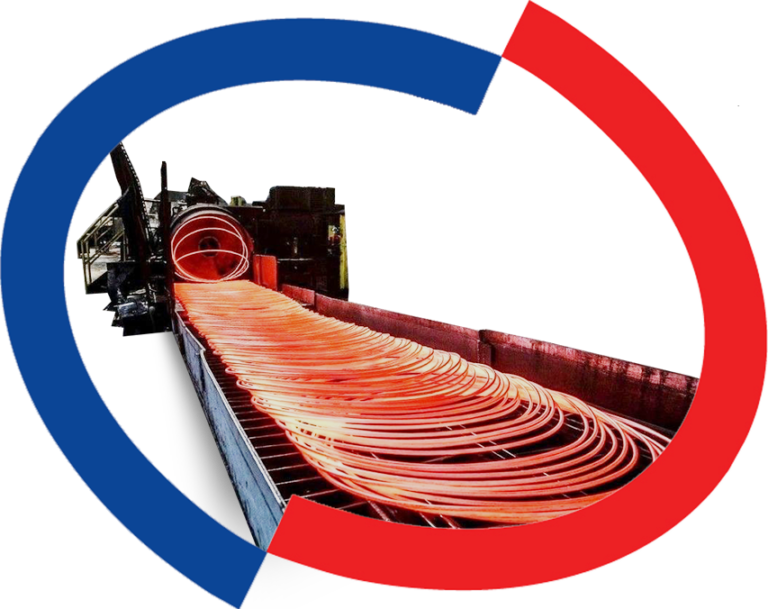
A wire rod mill is a high-speed rolling mill that converts reheated steel billets into coiled wire rod through a continuous hot-rolling process. In practice, it is one of the most important mills in long-product steel production because it sets the quality standard for downstream wire drawing, forming, and fabrication.
For steel producers, a well-designed wire rod mill is not just about output. It is about dimensional accuracy, surface quality, coil consistency, and the ability to serve different end-use grades reliably. That is why buyers, plant owners, and project teams often evaluate the entire line — from reheating to cooling — before choosing equipment or a supplier.
Direct Answer: A wire rod mill reheats billets, rolls them through a sequence of stands, guides the hot strand through a laying head, and cools it in controlled conditions before it is coiled and shipped for further processing. The output is typically supplied as coiled wire rod rather than as finished wire products.
What Is a Wire Rod Mill?
A wire rod mill is a rolling mill designed to produce wire rod from billets by hot rolling them through multiple passes in a continuous line. Modern mills are built for high speed, tight tolerances, and stable product quality — because the rod is usually rolled above 1,000°C and must still hold its shape and metallurgical properties as it travels through the line.
The output is typically wound into coils. Wire rod mills commonly produce coils weighing up to 2.5 tons, and the wire rod itself is generally supplied in small diameters for downstream use. To understand what a rolling mill is at its most fundamental level, it helps to first understand how different mill types serve different product families — wire rod being one of the most demanding.
Where It Fits in Steel Manufacturing
A wire rod mill sits after billet production and reheating. The billet is the input material, and the mill’s job is to reduce it progressively until it becomes a finished coiled rod. That rod is usually not the end product. It is a semi-finished feedstock for wire drawing, forging, and other secondary processing.
This is why the mill matters so much. If the rod leaves the line with poor surface finish, uneven cooling, or unstable dimensions, downstream processors will feel the impact immediately. Understanding the complete journey of steel through a rolling mill helps plant owners and buyers make more informed equipment and process decisions.
Wire Rod Mill Process: Step-by-Step
The wire rod mill process is continuous, fast, and tightly controlled. In a modern mill, the billet does not stop and start between every stage. Instead, it moves through roughing, intermediate, and finishing sections in one coordinated flow. Modern wire rod rolling may involve around 25 to 30 passes in a continuous mill.
| Stage | What Happens | Why It Matters |
|---|---|---|
| Billet reheating | Billets are heated uniformly before rolling | Supports surface quality and stable deformation |
| Roughing mill | Initial size reduction begins | Prepares the billet for further rolling |
| Intermediate mill | Further reduction and shape control | Keeps the line stable at high speed |
| Finishing block | Final dimensions are achieved | Sets tolerance and product consistency |
| Pinch roll and laying head | Guides the hot strand into coils | Ensures clean coil formation |
| Controlled cooling | Coil properties are adjusted during cooling | Helps define microstructure and mechanical properties |
| Coiling and inspection | Coil is checked, handled, and packed | Confirms quality before dispatch |
Step 1 — Billet Preparation and Reheating
The process begins with billet preparation. The billet must be reheated evenly before it enters the mill, because inconsistent temperature creates quality problems later in the line. Temperature control is especially important for surface condition, grain structure, and head-to-tail consistency.
In wire rod production, temperature management is not a minor detail. For smaller diameters, rolling time is longer, so the temperature drop from the head to the tail becomes more critical. The basics of reheating furnaces — from heating zones to temperature uniformity — directly determine how well the mill performs across the full rolling line.
Step 2 — Roughing Mill
The billet first enters the roughing section, where its cross-section is reduced, and its shape is prepared for the rest of the line. This stage starts the deformation process and sets up the metal for more precise reduction in the next stages.
In simple terms, roughing is the “first shaping” stage of the wire rod mill. The product is still far from its final size, but the line is already building the consistency needed for high-speed finishing.
Step 3 — Intermediate Mill
The intermediate stands reduce the section further and refine the shape before the strand reaches the finishing block. This stage is where speed synchronisation becomes critical, because the mill must keep tension, roll speed, and temperature under control across multiple stands.
A modern wire rod mill depends on stable coordination here. If the speed between stands is not managed properly, the rod can suffer from dimension variation, surface issues, or unstable coil formation later in the process. The hot rolling mill process demands continuous synchronisation — and wire rod mills push that requirement to its limit given the high operating speeds involved.
Step 4 — Finishing Block
The finishing block brings the rod to its final diameter and tolerance. This is one of the most defining parts of the wire rod mill, because it is where the line combines speed with precision. Modern wire rod mill systems are designed for high-speed production and typically incorporate reducing and sizing mills, advanced cooling technologies, and precise process control. This highlights the critical role of the finishing stage in achieving dimensional accuracy, surface quality, and consistent mechanical properties.
Step 5 — Pinch Roll and Laying Head
After the finishing stand, the rod is controlled by the pinch roll and the laying head. Their job is to guide the hot strand smoothly and form it into a consistent coil pattern as it leaves the mill. Positioned after the finishing block, the laying head controls rod tension and deposits the hot rod in a consistent coil pattern, supporting efficient cooling and coil formation.
Pinch rollers play a much more active role than many plant teams initially expect — they directly influence coil shape, tension consistency, and the way the rod enters the cooling conveyor. A poor coil pattern means handling problems, quality loss, and downtime. Good coil formation is one of the clearest signs of a well-run wire rod mill.
Step 6 — Controlled Cooling / Stelmor Cooling Conveyor
Cooling is not simply about reducing temperature. In a wire rod mill, controlled cooling helps shape the final microstructure and mechanical properties of the rod. Modern controlled cooling systems can accommodate different cooling rates for alloy, carbon, and stainless steel grades, helping manufacturers achieve the desired mechanical properties and microstructure.
That flexibility matters because different grades need different cooling rates. A line that can only cool one way is far less useful than one that can adapt to product grade, size, and performance requirements. The difference between hot rolling and cold rolling is particularly relevant here — because controlled cooling in a wire rod mill is what bridges the gap between the raw hot-rolled property and the final mechanical specification the customer needs.
Step 7 — Coiling, Inspection, and Packaging
Once cooled, the rod is inspected, handled, and prepared for dispatch. At this stage, coil shape, surface quality, and dimensional accuracy all matter because the product is about to move into downstream operations. Modern mills increasingly use automated systems to improve repeatability and section monitoring.
The value of a wire rod mill is not just that it produces metal in coil form. It produces consistent coils that downstream customers can process with less waste and fewer interruptions.
Main Components of a Wire Rod Mill
A wire rod mill is best understood as a system, not a single machine. Each component has a separate role, and all of them must work together.
- The reheating furnace heats billets uniformly before rolling.
- Roughing and intermediate stands progressively reduce section size and prepare the strand for finishing.
- The finishing block delivers final dimensions at high speed.
- Pinch roll and laying head guide the strand and lay it into clean coils.
- A controlled cooling conveyor manages cooling rate and final rod properties.
- Automation and control systems maintain speed, synchronisation, temperature, and section consistency across the line.
A strong wire rod mill depends heavily on automation. Reliable control systems are essential for improving size tolerances, mechanical properties, surface finish, tension control, and roll speed management. For complete wire rod and block mill equipment, Steefo supplies dedicated block mill systems for wire rod and TMT production that are built around these exact operational priorities.
What Comes Out of a Wire Rod Mill?
A wire rod mill produces hot-rolled steel rod that is collected and supplied in coil form. These coils are the form most buyers expect, because wire rod is usually moved to another plant for drawing, forging, or further forming.
In many mills, the rod falls within the small-diameter range used for long-product applications. Wire rod outputs are typically in the range of 5 mm to 12.5 mm in coil form, although actual product ranges depend on mill design and customer specifications.
It is essential to understand the difference between wire rod and finished wire products. Wire rod is the starting material; finished wire is the result of drawing and secondary processing. That is why wire rod quality must be high before it reaches downstream customers.
Uses of Wire Rod
Wire Drawing and Downstream Wire Products
The main use of wire rod is as feedstock for wire drawing units. During drawing, the rod is reduced to a smaller diameter and made into products suited for specific industrial or construction uses.
Common Applications
Wire rod is widely used to make products such as:
- Fasteners
- Springs
- Wire ropes
- Wire mesh
- Barbed wire
- Electrodes
- Cable and reinforcement-related products
- Automotive and hardware components
Industry Relevance
Different grades of wire rod serve different downstream industries. Wire rod grades can range from low carbon and mild steel to medium carbon, high carbon, and low-alloy steels — which explains why the same mill platform can support a wide variety of customer needs.
For engineering, automotive, construction, and manufacturing users, this flexibility is a major advantage. It allows the wire rod mill to serve multiple markets without changing the core production logic.
Why Process Control Matters in Wire Rod Mills
The quality of a wire rod mill product depends on the entire chain: reheating, rolling, laying, cooling, and automation. If one stage is inconsistent, the rest of the line cannot fully compensate. That is why modern mills are built around process reliability and operational flexibility.
Three factors matter most:
- Temperature affects surface condition, rolling behaviour, and final structure.
- Speed determines productivity and affects tension and coil formation.
- Controlled cooling shapes the final properties and microstructure.
A practical example helps here. Wire rod coils can reach up to 2.5 tons and lengths up to 10 km, while rolling speed can go as high as 140 m/s in high-speed mills. Those figures show why control is so important: at that speed, small variations can quickly become quality issues.
Wire Rod Mill vs. Bar Mill
A wire rod mill is designed for continuous high-speed coil production. A bar mill, by contrast, is generally oriented toward straight long products. The difference sounds simple, but it changes mill layout, cooling design, finishing equipment, and handling systems.
| Feature | Wire Rod Mill | Bar Mill |
|---|---|---|
| Product form | Coils | Straight bars |
| Rolling style | High-speed continuous rolling | Longer product handling |
| Key end equipment | Laying head, cooling conveyor | Straightening and bar handling systems |
| Main focus | Coil quality, speed, consistency | Straightness, length accuracy, and handling |
This comparison helps plant teams understand why a wire rod mill is not just a smaller version of a bar mill. It is a different production concept built around a different output. For buyers evaluating how TMT bar rolling mills compare in cost and operational structure, the wire rod line adds an entirely different performance dimension.
Conclusion
A wire rod mill is a highly specialised rolling line that transforms billets into coiled wire rod through a continuous process of reheating, rolling, laying, cooling, and coiling. Its performance depends on how well each stage is controlled, because the final rod is only as strong as the process that produced it.
For manufacturers, the real value lies in consistency. A well-designed wire rod mill contributes to superior coil consistency, tighter dimensional accuracy, and smooth downstream processing for various steel grades.
Frequently Asked Questions (FAQs)
1. What is a wire rod mill used for?
A wire rod mill is used to convert heated steel billets into coiled wire rod for downstream drawing, forging, and fabrication.
2. What are the main parts of a wire rod mill?
The main parts are the reheating furnace, roughing stands, intermediate stands, finishing block, pinch roll, laying head, controlled cooling conveyor, and automation system.
3. Why is controlled cooling important?
Controlled cooling helps manage the rod’s microstructure and mechanical properties. It also allows the mill to adapt cooling rates to different grades.
4. What products are made from wire rod?
Wire rod is used to make fasteners, springs, wire ropes, mesh, barbed wire, electrodes, cable-related products, and automotive components.
5. Is wire rod a finished product?
No. Wire rod is usually a semi-finished product that is further drawn or processed before final use.
Looking for a Trusted Partner for Your Wire Rod Mill Project?
If you are planning a new wire rod mill project, upgrading an existing line, or evaluating turnkey solutions for long-product production, the right technology partner matters. The Steefo Group is a leading rolling mill manufacturer in India with manufacturing facilities in Changodar, Ahmedabad, and a strong focus on rolling mill design, manufacturing, and turnkey project execution.
As a trusted name for plant engineering and rolling mill projects in Ahmedabad and across the globe, Steefo Group supports clients with rolling mill plants, wire rod lines, and turnkey solutions for steel plants. Beyond supplying equipment, the company works closely with customers to address technical, operational, and project execution requirements.
Talk to us at +91 87589 98607 or email us at marketing@thesteefogroup.com to discuss your wire rod mill requirements and explore solutions designed for productivity, quality, and long-term performance.